
2-Execution
Published:
Pipeline
Physical implementation may have multiple stages pipelined
- F (2 stages)
- D (1)
- RR (1)
- X (3)
- RW (1) Add more pipelines, executing multiple instructions in parallel!
- Write parallel programs -> request level parallelism
Depth Limit
Diminishing returns on FF setup hold.
Let delay be \(L\), split into \(k\) stages, latch overhead be \(o\), \(t_{clk}(k) = \frac L k + o\)
Super Scalar (in-order)
Executes multiple instructions per cycle (pipeline + parallel per stage)
- In fetch stage, fetch n instruction.
- Decode n
- Read 2n from register read
- execute, writeback
Need
- Hazard detection
- Load/store queue for memory ordering
- Register renaming
- Branch prediction
Parallel Let compiler optimize it. Compiler will package them to parcels
- VLIW machine (Very Long Instruction Word)
- Compiler need to package independent instructions into parcels that can be all executed at once
- If can’t parcel, leave slots as empty, cut off the parcel
Instruction Level Parallelism (ILP)
for (int i = 0; i < n; i++) {
	result += x[i] * y[i]
}
Unroll dot product to extract parallelism (done by compiler), as long as you know what n is
for (i = 0; i < n-4; i+=4) {
	result += x[i] * y[i]
	// ...
	result += x[i+3] * y[i+3];
}
Simple in-order Superscalar machine
Superscalar pipeline: IF, ID, RR, EX, WB (x4, 4-way)
- Only need 1 IF, which emits 4 instructions simultaneously (cache locality)
- Still need 4 ID for 4 instructions
- Register file needs a different architecture
- Forwarding logic (will be complicated, since need to consider 4 EX units)
- 4 EX
- 4 WB (need 4 ports)
Solutions
- Beef up the HW
- Compiler optimization in SW
- Branch prediction optimization
- If diminishing returns, use parallelism
Fetching
- Input: program counter (x4)
- Output: the instruction (x4) We have the instruction cache (E. 64B lines, each instruction is 4B wide. You read 16 instructions at once). In scalar pipeline, you only use one of the 16
In a superscalar pipeline, you can use all 16 (more at same cost)
- In case of jumps, only a subset of the fetched ones will execute
- Solution: Still execute, and throw away the stuff not needed (predicated execution)
- Or branch prediction
VILW
Very Long Instruction Word, compile instructions into independent blocks
- Simple hardware
- Compiler does scheduling
- If compiler does good static analysis VLIW processor, given a control flow graph, look all all instructions within one basic block, put into a single packet
Blocks
- Basic block: any single-entry, single-exit region of code
- E.
if (cond) {//A} else {//B} - Only way to jump to the start is through the condition
- Only way to exit are the ends of the block, if no other condition statements in A and B.
- E.
- Arrange of basic blocks are control flow graphs
- Data flow graphs: link operations by true data dependencies within a block
Super Block
E. P -> A/B -> C becomes tail duplicated to (P A C) (P B C) (two packets)
- Now multiple exits. If you want to jump to the B block, needs to exit again
- Eliminates control flow, linear code Drawback: increased code size
Hyperblock
Also duplication, but for small branches, do predication (if conversion)
- For a branch, execute both sides
Compilers have limited scope to optimize. Need dynamic scheduling at runtime to assign instructions to execution units
- How out-of-order superscalar processors do speculate the next code to execute.
Drawback
- Large code size
- Can’t handle unpredictability well
- Memory aliasing (tell if they are dependent)
- Branches
- Execution may be wasted
Speculation
Branching types: need a condition and target
- Conditional: branching
- Unconditional: jump
- Direct: specified as part of the instruction (immediate, PC relative, PC is available in the first pipeline stage)
Indirect: specified from a register (more dependency)
- If wrong prediction, cause 3 bubbles in the pipeline
- Only \(\frac 2 5\) IPC, due to 3 cycles wasted
- Need to predict both the condition and the target
Procedure
- Store a big table of branch PC
- When fetching a PC, consult this table, and find the target PC
- How to validate a guess? Identify the ground truth
- For unconditional (jump), remember the
jmptarget. Check if target matches with the next address - When
jmpis in RR (target read), compare with the next address - (Wait for the oldest instruction in the pipeline to be non-speculative)
- For unconditional (jump), remember the
- Fix the branch predictor if needed
Implementation
- Local history conditional predictor
- Infer with previous outcomes of the same branch
for (int i = 0; i < a; i++)
	for (int j = 0; j < b; j++)
		// ...
- Lookup table that takes n bits from the PC. Store one or more bits on if the branch is taken
- Can fit \(2^n\) bits
- 1 because can store even further histories (hysteresis)
- E. If taken/not taken twice, then change prediction
- Can fit \(2^n\) bits
counter[PHT_SIZE];           // 2-bit saturation counter
hlen history[HIST_TABLE_SIZE];    // local history for each

bool predict (unsigned long long int pc) {
	unsigned int histIndex = pc & (HIST_TABLE_SIZE - 1);
	unsigned int phtIndex = history[histIndex];
	return counter[phtIndex] & 0x2; // 0, 1: not taken; 2, 3: taken
}
Target Buffer
- Hash the PC into a tag.
- Compare if tag matches a PC.
- If so, jump to target address Lookup happens in parallel with branch address decode
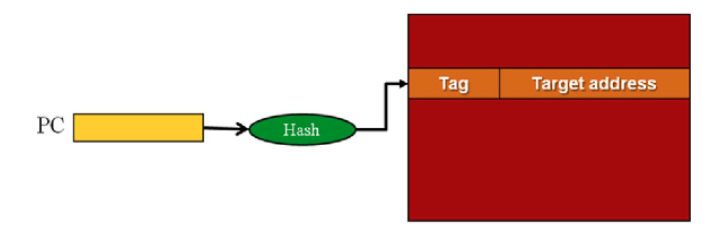
- If so, jump to target address Lookup happens in parallel with branch address decode
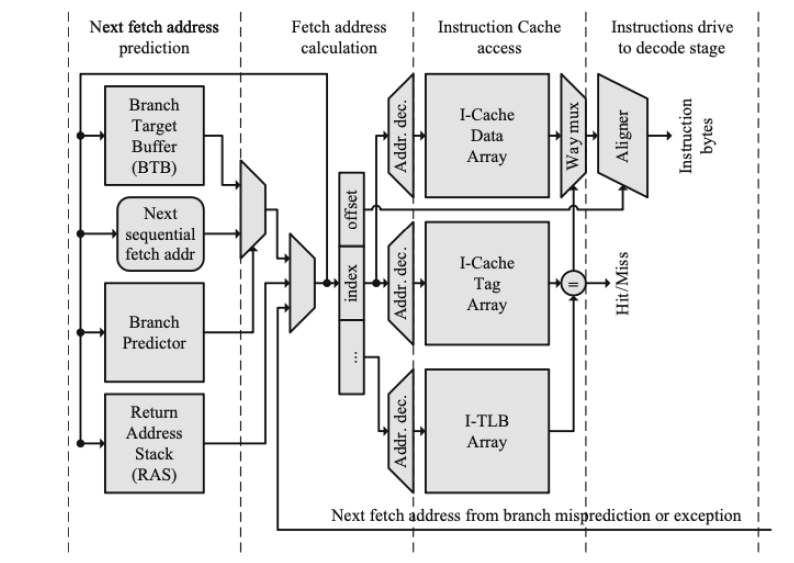
MUX from various sources (sel based on heuristic. If something hits in BTB or RAS, prioritize them)
- MUX: Select bit from branch predictor
- Branch Target Buffer, or
- Next sequential fetch address
- Return address stack (RAS)
- Next fetch address from branch misprediction or exception (outside of fetch)
Scalability: Little’s Law
Deeper pipeline:
- Higher frequency
- More in-flight instructions
- More in-flight branches
- Need high branch predictor accuracy
E. 20-stage processor, 4-way superscalar. Can have 80 instructions in flight Reorder buffer size: 80 Fetch: 8 inst/cycle / 4 = 2 branches / cycle needed
Fetching from instruction cache
- Instruction may be in different blocks in I cache
- I cache needs to be multi-ported (slow) Decode: relatively easy for RISC, but CISC can have multi-bit instructions
- CISC converts CISC ops to RISC ops, put them in trace cache Register Renaming: 8 instructions at a time
- Issue queue Execution Unit
- Reading operand is hard. Need to read from RF
- RF needs to be large. Practically split to multiple cycles
- Forwarding: Every execution unit needs to send value to every other unit (nxn crossbar, hard to scale)
Return address Stack
Hard to predict, since a function can be called from different places Luckily, calls and returns have special semantics
- Push callee’s next sequential address into stack
- When return, pop the stack, and use this address as my next prediction
- Allows storing multiple target addresses from the same PC (function)
- Mispredictions
- If stack overflows, some entries are overwritten
- Wait for the return to be non-speculative. Then compute the address
Two pieces: address stack and link stack
callcommit- Update call target address in Call Target Buffer (CTB)
- Push CTB index on
RASlink stack
- Return commit
- Pop CTB index
Summary
Global History Predictor
Outcome of a branch is typically related to previous outcomes of other branches
if (cond) a = 2;
// ...
if (a == 0)  // ...
- Hash 30-40 bits of branch history with PC, and store in a table to lookup Use another metapredictor to decide whether to use a local/global predictor
Neural Branch Prediction
Online supervised machine learning
- Online: not pre-trained
- Make and remember the guess
- Check if guess is correct
- If guess is wrong, flip prediction next time
Simple neural network (single layer, single node)
- Take PC hash to get one set of weights
- Look up the table of model weights
- Multiply each weight with global history register
- Sum each neural branch to a function
Update If match, go to the register history.. Increment every branch where i == outcome
Example
for (int i = 0; i < 100000; i++) {
	array[i] = 1 % 5;
	if (i % 2 == 0)
		// do something
	else
		// do else

	switch(array[i]) {
		case 0:
			// something
			break;
		case 1:
			// something
			break;
	}

	func();
}
Control flow transfers
forloop- Local history (always predict not taken, so you
forconstantly)
- Local history (always predict not taken, so you
if- Local history with hysteresis
switch(5 branches)func()(unconditional)
Case statement loads to a jump table
	lsl r3, r3, #2
	add r4, r3, JUMP_TABLE
	ldr r0, [r4]
	br r0

case_0:
	b increment_loop

JUMP_TABLE:
	.word case 0
	#...
basic_block_1:
	a5 = a6 + a7
	b ...

...
	b ...

basic_block_2:
	a18 = a5 + a7
	b ...
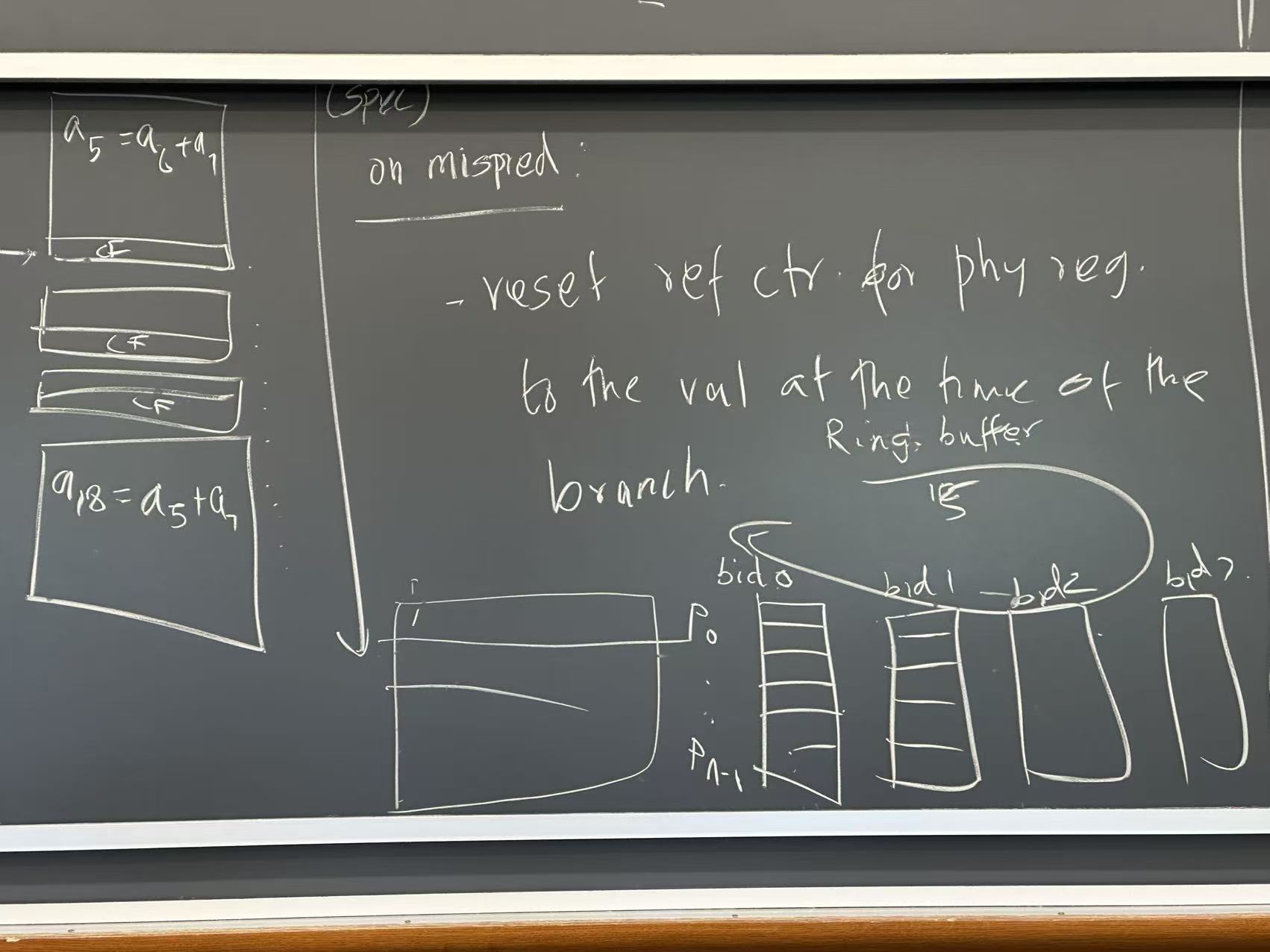
Suppose the branch of basic_1 is mispredicted
- Need to reset physical reference counter for all physical registers to the value at the time of the branch, since the usages are no longer executing
- Naive approach: checkpoint counter values at each branch
- Ring buffer of checkpoints
- Serial process, either in time or space
OOO
Program Order
Reference machine: programmer’s mental model
- Exactly one instruction each time
- Execution is atomic and uninterrupted
Semantics
- \(s\): set of architectures states (PC, register, memory, configuration info)
Inst: instruction set- \(s \overset{I} \rightarrow s'\): \(s\) yields \(s'\) in an atomic step in \(I\)
Given program \(p\) and initial state \(s_0\) obtained from program arguments and environment
\[s_0 \overset {I^{(1)}} \rightarrow s_i \overset {I^{(2)}} \rightarrow s_2...\]The dynamic trace: trace actually executed
\[\tau = \langle I^{(1)}, I^{(2)}, ...\rangle\]Per-thread program order: If \(i < j\), \(I^{(i)} \prec_{po} I^{(j)}\), then in execution commitment
- May not be order internally, but the architectural behavior must be preserved
Correctness obligation
Microarchitecture is precise if the commit sequence is order-isomorphic to \(\tau\): commits preserve \(\prec_{po}\), with no extras/omissions
Can reorder internally for performance, but must commit program order
- Performance: fetch/execute out of order
- Correctness: commit in order
Reorder Buffer (RoB)
Fetched instruction put in a big queue in program order. Tracks every in-flight instruction
- A bag for picking independent instructions
- aka instruction window, reorder buffer
- 64-512 instructions typically
- Instruction picker: determines which instructions in the queue are independent
- Selector: selects the picked instructions and pull out from queue to execution
Implementation
Assign each fetched instruction a bounded age in a ring reorder buffer of size $N$
- Track head and tail (next free age)
- Stall if ring full
- If misspeculation, roll back to the youngest correct instruction
- Commit in ring order to preserve $\prec _{po}$
- Each entry can have fields
{valid, done, exception, result, PC, dst} - In-flight instructions $\leq$ N
- May not be physically implemented in one place
Algorithm
A queue
- Head: age of oldest
- Tail: next free age
Fetch
- If ROB full, stall.
- If free, allocate tail, mark valid, mark
done = 0, set metadata,tail++(mod $N$) Execute - When an age finishes, set it done, store result/exception Commit (in-order)
- When
RoB[head]is valid & done & no fault- Update architectural state (state sent to programmer) with the
RoB[head].result free(RoB[head])head++(mod \(N\)) Misprediction
- Update architectural state (state sent to programmer) with the
- Recover to correct age
y- Invalidate all younger entries in
range(y, tail) - Reset tail:
tail = (y+1)(mod n) - Redirect fetch to the correct PC Exception (generated synchronously by the instruction)
- Invalidate all younger entries in
- Stop commit at head
- Flush all younger instructions in the pipeline
- Trap at the faulting instruction Interrupt: external async
- Can finish current execution, flush everything, and trap to interrupt handling routine
Why preserve sequential semantics
- No missing/extra: every fetched op either commits or flushed
- No duplicates: ages are not reused until commit/flush
- Order: head-first commit, same as \(\prec\) on the correct path
Dependency
- Register
- Memory Data flow graph
flowchart TD
    A(I1) --> B(I2)
    F(I0) --> B
    B --> C(I3)
    B --> D(I4)
Can be executed in 3 cycles. Ideal ILP: \(\frac 5 3\)
- True dependency
- Read After Write
- Fake dependency (no data flow. Can be mapped to different physical registers)
- write after write (output dependency, later write must appear after)
- write after read (antidependency, same)
Compiler creates code using single static assignment. Every time a variable is created, a new name will be given. Does not have WAW and WAR issues at all
- When code is sent to hardware, it needs to map all variables to a finite set of registers
- Creates WAW and WAR issues
Compiler good at array-based loops and no aliasing.
add r1, baseA, i
add r2, baseB, j
store [r1] = t0
load t1 = [r2]
Dependency unknown before runtime!!
store.b [r1] = b0
store.2 [r1-1] = w0
load.2 t1 = [r1]
Need to wait for both stores to finish, before the load
Done with dependency prediction
Register Renaming
Increase the set of registers to avoid name conflicts
- Rename Architectural register (~16) -> physical register (microarchitectural,~360)
- Subsequent references to architectural are all mapped to physical
- On commit, physical registers are copied to architectural registers
- Special stage in pipeline: renaming
- Find last use of physical register and return it to the free register list
- Also free if it’s not architecturally visible
Reference Counting
Find the last use of a register
- Use:
count++ - Commit to a consumer:
count-- - Misprediction:
count-- count == 0: return to free list
E.
a5 = a6 + a7at decode. Assume thata6anda7are both committed.a5is a new definition
- Every register on LHS is a definition
- Everything on RHS is a use
- At rename stage, define
P9 = a6 + a7- A new name is allocated for
a5(destination only) - Reference counter of
P9 = 0
- A new name is allocated for
- Later, if get another instruction
a18 = a5 + a7- Allocate
P21 = a18 P21 = P9 + a7- Uses
P9,counter[P9] = 1
- Allocate
- When
a5 = a6 + a7commits, no change - When
P21 = P9 + a7,counter[P9] = 0P9is put in the free list
Dependency Predictor (LSQ)
Also a ring buffer indexed by age Safe if
- All old store address known and disjoint from load
- An aliasing S/L data is ready and can be forwarded When load address generated, check older stores address and size
- Pick the youngest older instruction
- Issue, forward, and speculate When store address generated, check younger loads
- Squash/replay
I0: st x
I1: st x
I4: ld x
I7: ld x
Suppose the execution is I4, I0, I1, I7
I4, x. No matching older stores (yet), gets the value from cacheI0, x. Look for younger instruction (I4), but I4 instead received from cache.- Misprediction. Need to squash. Younger loads are
I4,I7are squashed - Record that
I4depends onI0 I0is executed, reset the PC toI1Suppose we now getI1, I4, I7
- Misprediction. Need to squash. Younger loads are
I1I4finds the youngest store, gets the value fromI1
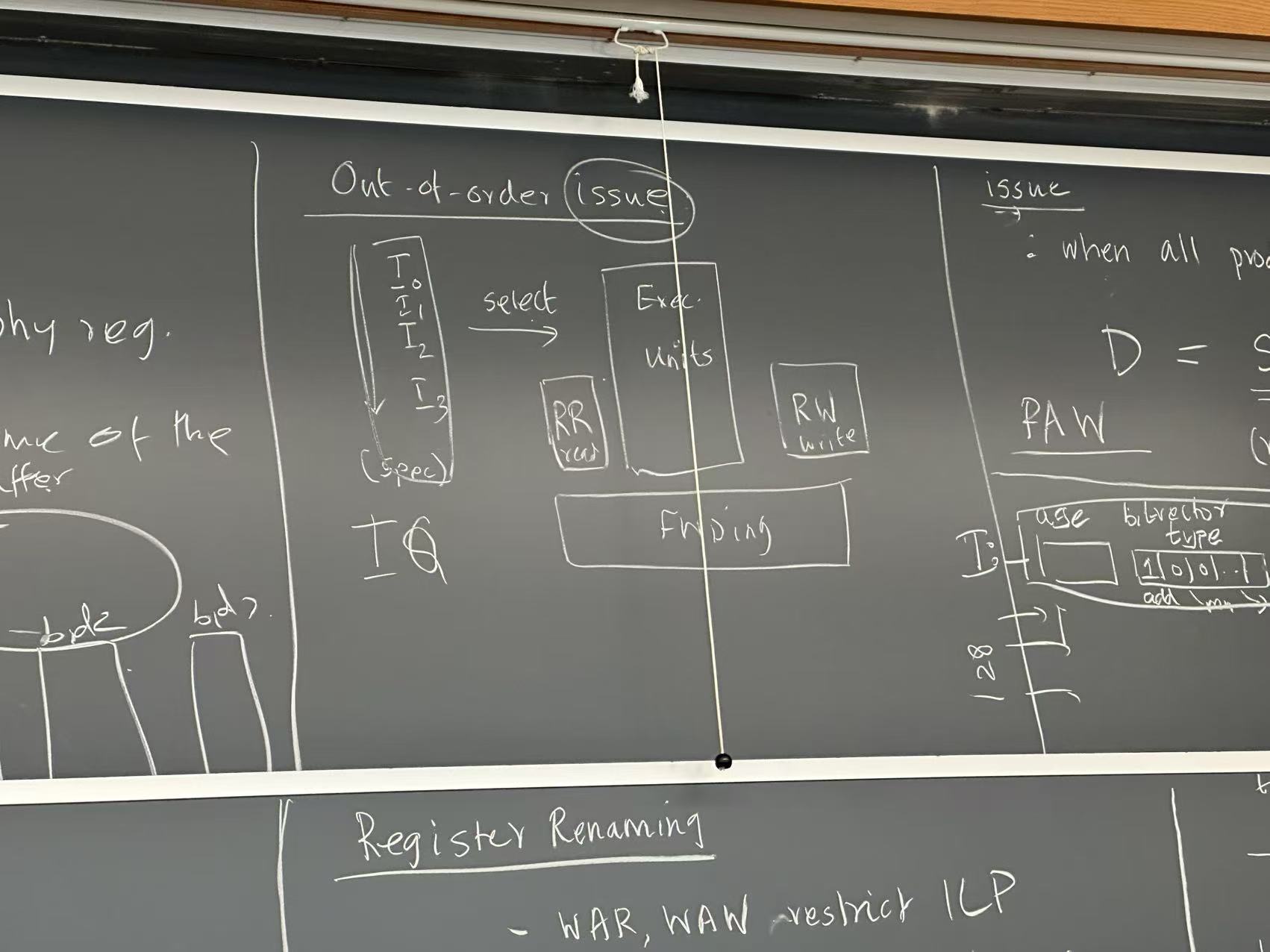
Issue Queue (execution)
- Age
- Bitvector type (operand)
- Left src
- Right src
- Destination
- When execution complete, broadcast destination register to the issue queue
- Compare the destination with the L and R sources
- Set \(\mathrm{ready}_L\) and \(_R\)
- Valid
- Is the queue entry occupied?
- Ready
- \[\mathrm{ready}_L \land \mathrm{ready}_R \land \mathrm{avail}(+)\]
May use CAM (content addressable memory), searchable
- Power hungry, and don’t scale
- Limits the size
Summary
- When source execution completes, broadcast tag (physical register)
- Instruction is available if all physical sources are ready, and no hazard
- Choose up to \(W\) eligible entries and issue to ALU
Result may be forwarded
- Fetch: branch prediction, RoB allocation
- Rename: map architectural -> physical
- Add to issue queue by instruction class
- Issue: check eligible, send to ALU
- Execute
- Writeback/broadcast to RoB and wake dependents
- Commit in RoB order, free physical register; handle trap
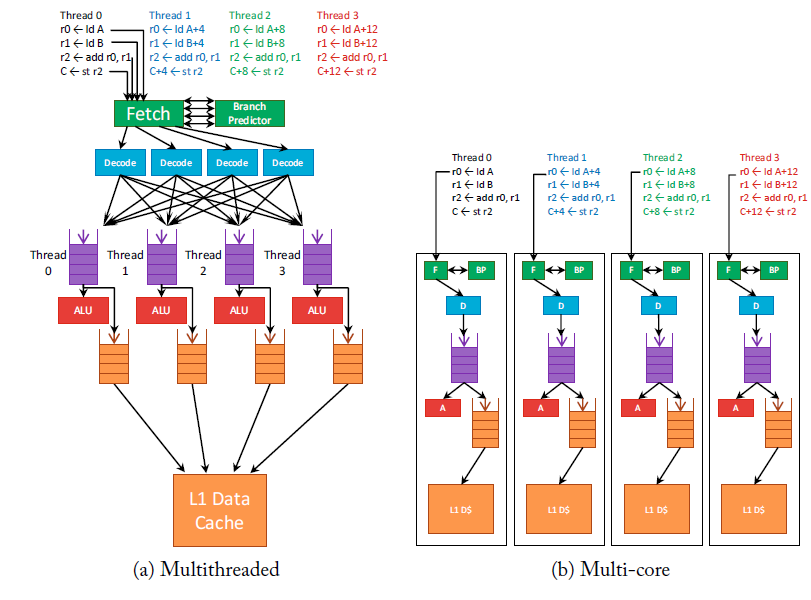
Simultaneous Multithreading (SIMT)
Issue OOO from multiple threads
- Vertical waste: none of the execution units are used
- Waiting for memory
- Missed instruction cache
- Horizontal waste: some of the units not used
- E. no execution unit available
Fine grain multithreading
Share pipeline between multiple threads. Processor can switch between contexts (thread) while waiting for instructions on the other
- Switch with no delay
- Solves vertical waste
- Not horizontal waste Horizontal waste: simultaneous multithreading Put several threads on the same core: mix and issue instructions from different threads in the same execution slot
E. GPU are fine-grained multithreaded processors
- Switches on misses, avoid long-latency events
Multithreading support
- A PC for each thread
- Shared TLB
- Shared instruction cache
- Register map and HW resource, instruction queue are partitioned statically between threads
- Data cache is shared
- E. one thread needs to have a large data cache to avoid misses. If cache shared, that thread will have reduced throughput
- Still better to share for most cases
Vector Computing (SIMD)
single-instruction multiple-data execution (SIMD) Important: reading
No OoO, just standard superscalar
ro = ld A
r1 = ld B
r2 = add r0, r1
C = st r2
# repeat 4 times for an array
Need 16 fetch, etc.
Vector instruction SIMD
v0 = vld A
v1 = vld B
v2 = vadd v0, v1
C = vst v2
Only need 4 fetches. Everything is single.
- Just dependency check if
v0andv1are available. Don’t have to repeatedly checkr0andr1 - ALU is 4 times as wide Significantly reduces energy: more work per instruction
- Need new vector instructions and wide function units
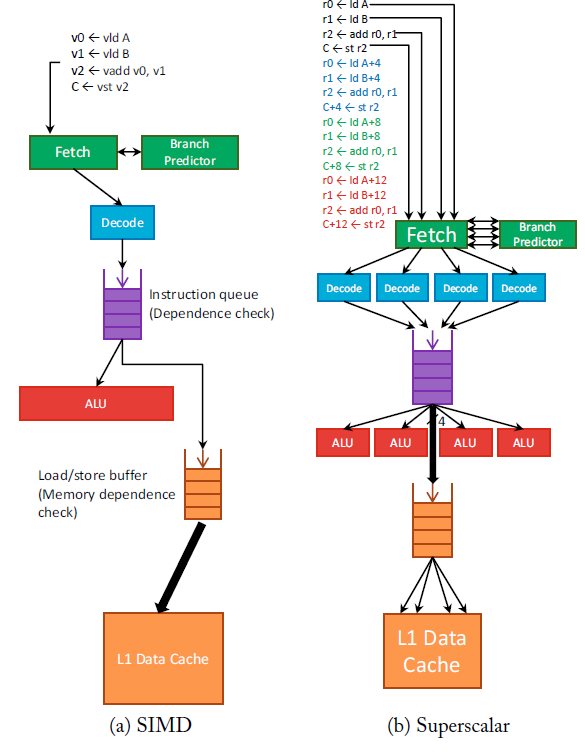
Also larger structures don’t scale as well.
If width don’t math, first/last do the remainder in scalar mode, and then do the rest in vector
- Speedup limited by the serial version
Registers
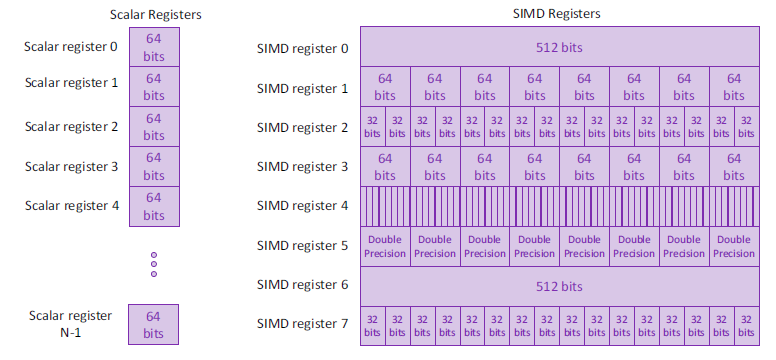
Fewer registers, but can be interpreted differently
Resources
AVX 512 Wikipedia intel.com/content/www/us/en/docs/intrinsics-guide/index.html
Conditional store
for (i = 0; i < n; i++) {
	if (A[i] > 0)
		B[i] += C[i]
}
for (i = 0; i < n; i += VLEN) {
	vload v0, B[i]
	vload v1, C[i]
	vadd v2, v0, v1
	vstore buffer, v0

	for (j = 0; j < VLEN; j++)
	}
If division, may have exception
Blend instruction that takes two inputs, and use MUX to choose one value
for (i = 0; i < N; i ++ VLEN) {
	vload v0, A[i]
	vxor v1, v1, v1 /// clear v1
	vcmpgt m0, v0, v1   // mask register

	vload v2, m0, C[i]
	vadd v3, m0, v0, v2

	vload v4, m0, B[i]
	vadd v5, m0, v3, v4
	vstore B[i], m0, v7
}
Memory operations
Unaligned axis: do not align with cache lines Use compiler .align
Stream
For a particular access, make cache not write allocate: when miss, directly stream the values and copy in the RF. Does not cache
- On a store, skip cache and directly store DRAM (not likely reused)
- Avoid polluting large amounts of cache
Non-contiguous
Sparse gathering of data Sparse matrix multiply
Horizontal Operation
- Speculative execution
- Scheduling (SW, HW)
- Execution (in, OOO)
- Multithreading (fine-grained, coarse grained)
- Parallelism extraction (by programmer, compiler, or HW)
For scalar pipeline, benefit from
- Speculative execution
- Scheduling (simple HW for scalar, but need good compiler SW optimization)
- In-order execution
- Multithreading: only one decoder, execution unit, etc, so can’t multithread
- Useful for speculative instruction on high-latency events such as memories (latency hiding)
- Intellectural precursor to GPU: programmer expresses computation as a scalar thread. When waiting, hide latency by switching to multiple threads
- Parallelism from compiler For VLIW processor, For OOO, superscalar processor For GPU, For vector processor with SIMD