
Operating Systems I
Published:
Here are my OS notes:
These notes were not taken in any careful or organized manner, because:
- The slide format makes it incredibly difficult to distill and coalesce the key concepts real-time
- There are plenty of great material on specific topics, see below
- Most of my comprehension happens during late-night debugging, instead of deliberate note-taking.
Some of the homework/recitation notes are omitted, as they lead directly to solutions.
Delivery
If you take OS with Kostis (or descendants of his version), you are in a challenging state. Personally, I don’t like using slides to deliver the Columbia OS curriculum
Systems are best understood as an unbroken, continuous stream of concepts. Slides fundamentally constrain knowledge within artificial rectangular boundaries, leading to problems such as:
- Filler text and verbose background info simply to pad the dead space of a slide template.
- Squeezing multiple text/diagrams/schematics of a complex topic onto a single slide
- Incomplete/segmented code snippets on multiple slides
- Poor portability (you can’t cleanly copy code in a slide layout)
These characteristics make learning difficult, for both students and instructors
- There are also debates on logistics and grading, which merit their own discussion…
Resources
I recommend referencing Jae’s OS course page from Spring 2023, the good old days! (It’s publicly accessible via Jae’s homepage)
Here are also some very useful guides written by former Head TA Alex Jiakai Xu, previously posted on EdStem.
You can check out more awesome articles in his GitHub page
Here’s a scheduler state diagram I made when reviewing for the finals 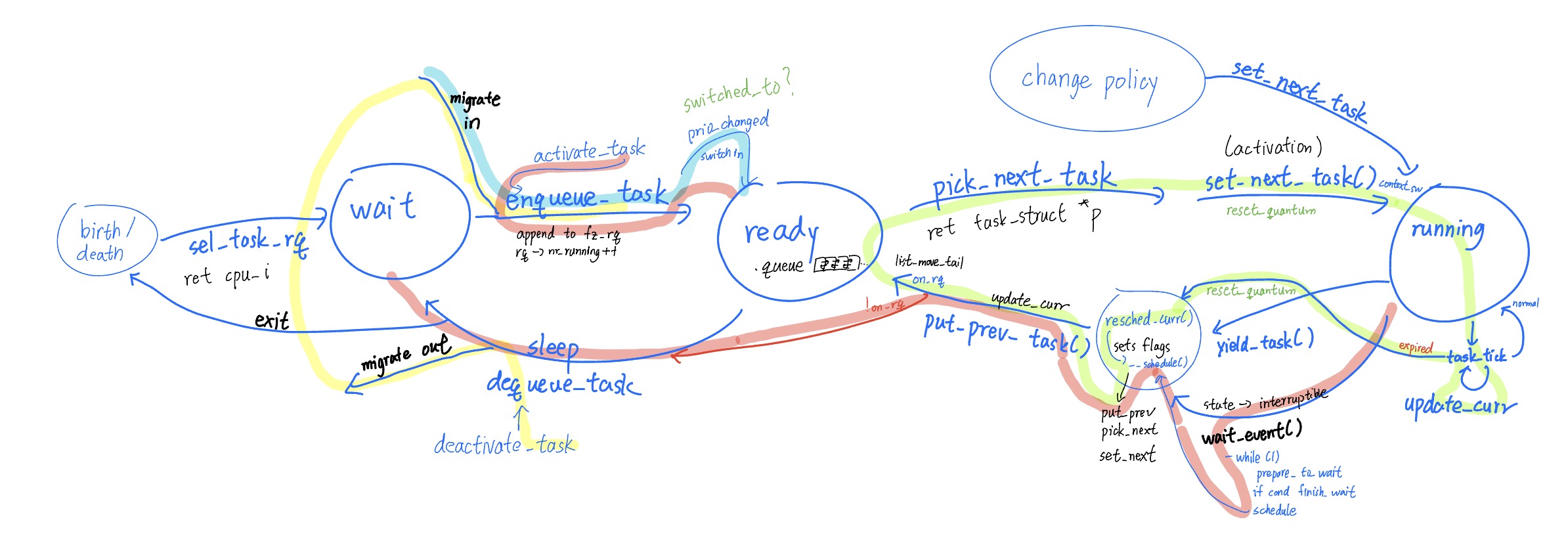
- Green: normal pick – run – preempt – put loop
- Red: wait – sleep – wakeup routine
- Yellow: load balancing (between 2 CPU/runqueues)
- Blue: task switching schedule classes