
OS Notes: Disk and IO
Published:
18.1. IO
- Issue commands to device
- Catch interrupts
- Handle error Diverse, portability, performance
Category
- Block Device
- Info stored in fixed-size blocks, with its own address
- Transfer in one or more blocks
- E. hard disk, CD ROM, USB
- Character Device
- Info sent/received in stream
- Not addressable
- E. mice, printer, network interfaces
Controller and Device
Device expose a finite set of registers to communicate with CPU
- Command buffer for start/stop
- Data buffer that can be read/written
- E. address, size
Communication Methods
1. IO Port Space
Old interface, two address spaces
- IO port, number assigned
- Access with privileged instructions
in portnum, targetout portnum, source
2. Memory-Mapped IO
Mapped to some unique physical offset
- Device listens (snoops) a physical range
Advantages
- Written in C
- No special protection
- Convenient memory interface
Communicate through struct pci_config
- Inspect with
lspci
Need to disable cache!!!
- Through page table
cache_disabledbit
Interrupt
Raise interrupt when device finished work (or wants attention)
- Interrupt controller issues interrupt
- CPU acks interrupt
Message Signaled Interrupts
- Pin count restrictions Write a small interrupt-describing data block describing data to a special
mmap()ed IO address triggers interrupt - Very programmable
Precise Interrupts
Simple
- PC saved in known place
- All instructions before fully executed
- All instruction after not executed (or no side effects)
- Execution state of PC known
What if OOO, many instructions in-flight? Which instruction gets interrupted??
IO Software
- Error handling
- Close to hardware as possible
- Sync vs async
- Buffering
- Sharable
Performing IO
Programmed IO
- CPU does all work
- Busy-waiting (polling)
copy_from_user(buffer, p, count);
for (i = 0; i < count; i++) {
	while (*printer_status_reg != READY)
		;
	*print_data_register = p[i];
}
return_to_user();
- Waste CPU cycle
Interrupt-Driven IO
Process blocked while waiting, another process scheduled
- When ready raises interrupt, then copies data
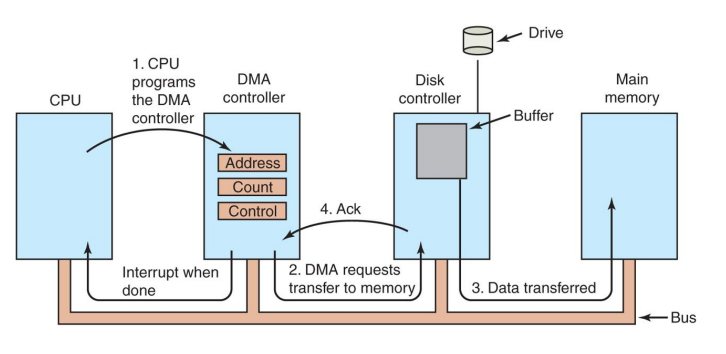
Direct Memory Access (DMA)
Ask DMA controller to move data as a bulk
- Has access to system, but independent from CPU
- When DMA controller moves data, CPU can do something else
- aka “copy core”
- Interrupt when done
Memory Protection
Security concerns
Protection with another translation table: IOMMU
- Similar to page table protects via MMU
- If invalid address, exception raised
Example Devices
Clock
HW
Crystal oscillator + pulse counter + holding register
- Interrupt when counter becomes 0
SW
E. CPU stat, preemption, alarm call, system watchdog (deadlock detection)
When process sleep(10), need to release this process from blocking state after 10 s Create a clock header that wakes a sequence of events
Network Driver
Receive: Network card need to maintain an ring buffer
- Throttle TCP/IP or device, when either side too frequent
- High degree of concurrency
18.2. Storage Devices
HDD
- Cylinder and sector (512b each)
- RW head
New devices expose uniform Logical Block Address
- Disk controller translates LBA to CHS
- OS views as 1D array of sector groups (blocks)
Sequential access much faster than random
Seek Performance
Move to specific track and keep it there
- Need more accurate for write, since errors are catastrophic
- Seeking (track)
- Critical for small loads
- Should to be optimized, schedule requests to shorten seeks
- Move some data to memory: file system caching
- Rotational delay (sector)
- Critical for sequential transfer
- Byte transfer
- Much wasted
Disk Management
Placement/ordering requests
- Make as sequential as possible
- Group as long seeks
- Con: if crash, may leave in inconsistent state
Considerations
- Internal/external fragmentation
- File growth
- Sequential/random access time
- Metadata overhead
1. Contiguous Allocation
FS allocates space all at once
- Space managed by examining bitmap
- Metadata: base, size (simple)
Pros
- Easy, low overhead
- Fast sequential access
Cons
- External fragmentation
- Can move around
- Hard to grow
2. Extent-Based Allocation
Multiple contiguous regions for file (extent)
- ana. memory segmentation
- Metadata: array of (base, size)
3. Linked Allocation
Data block part of linked list
- Metadata for next pointer
Pros
- No external fragmentation
- Similar to paging
- File can grow easily
- Easy to implement
Cons
- Slow sequential access
- Hard to compute random access
- Some overhead
The LL pointers can be stored in a dedicated pointer table
Pros
- Faster random access: FAT lookup
Cons
- Slow sequential
- Need recovery when crash
4. Indexed Allocation
Metadata: Array of pointers (index) to data blocks
- Blocks allocated on demand
- i-nodes
Pros
- No external fragmentation
- Easy growth
- Multiple levels of indexing
- Fast random access
Cons
- Overhead: index blocks
- Slow sequential
Scheduling Disk Requests
1. First Come First Served
Process on the order received
- Easy, fair, but no locality
2. Shortest Positioning Time First
Pick request with shortest seek time
- High locality, throughput
- Starvation
- Don’t know which request fastest
3. Elevator
Sweep across disk, serving all requests passed
- SPTF, but only in one direction
- Switch direction only if no further requests
- Locality, bounded waiting
SSD
Organization
Page -> block -> plane (parallel access) -> die -> chip
Functions
- Read
- Very random! Less power, faster
- Erase
- Program Write takes two steps
Writing
Need to be done at block level
- Backup
- Erase
- Change some pages in memory
- Re-program from memory to SSD
Very expensive!
- May wear down cell!
- Will not write in place, due to wear balancing
In-Memory Map
Keep memory map of logical -> physical page number
- On write, pick unused page, mark previous page free
- Repeated write will remap
Metadata
- Allocated
- Written
- Obsolete
100: after power failure, partially written state
Requires a lot of memory, wastes RAM in host
- Solution: store FTL map in flash itself!
Problem: write amplification
- Small writes to empty blocks will lead to intense fragmentation!
- Must periodically defragment
Disk Scheduling
No seek time for SSD
- No op: pass request directly to device
- MQ-deadline
- Wear Level Focus: coalesce write
RAID
Redundant Array of Independent Disks
- Used as SLED (Single Large Expensive Disk) logically, but each block may parallel IO
Hard Drive Errors
- Checksum error
- Transient
- Permanent: catastrophic
- Seek error: aggressive overshoot
- Programming error: requesting nonexistent sector
- Controller error
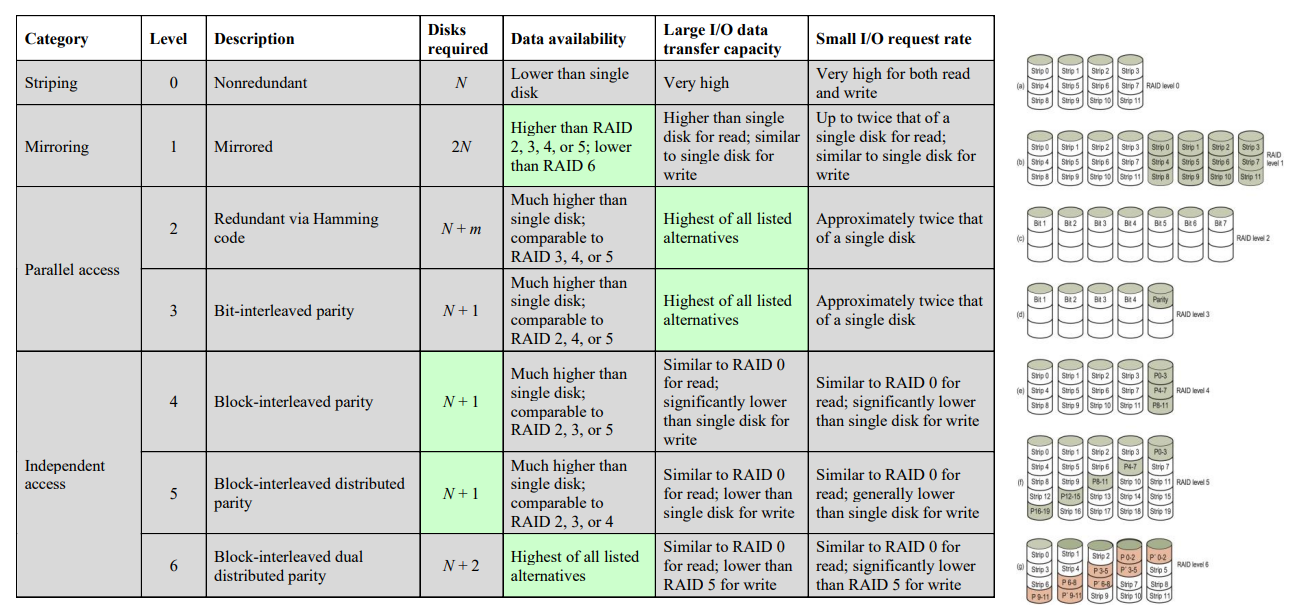
RAID Levels
- Level 0
- No redundancy, just logical partition into strips
- Level 1
- Duplicate all data
- Double the cost :(
- No write penalty (parallelized)
- Level 2
- Data striping (very small)
- Parallel access
- Use Hamming code for ECC (\(\log(N)\))
- Correct 1 bit, detect 2 bits
- Data striping (very small)
- Level 3
- Similar to 2, but only single redundant disk
- Independent of disk array size!
- Parallel access
- High data transfer rate, but only one IO at a time
- Similar to 2, but only single redundant disk
- Level 4
- Larger strips
- Bit-by-bit parity strips, all stored in parity disk
- Write penalty when IO
- Level 5
- Level 4, but parity distributed across all disks
- Loss of any one disk is fine
- Level 6
- Two parity calculations, stored in separate blocks on different disks
- Substantial write penalty
Logical Volume Manager
Volume: partition of hard drive
LVM allows combining physical partitions to volume groups logically
- IO requests directed to correct physical disk
19. Linux File System
Original UNIX
- Superblock: sentinel (E. number of blocks, pointer to free list)
- Inode: contiguous block, point to data
- Data
Problem: slow
- Blocks too small
- Index too large
- Transfer rate low
- Poor clustering related objects
lsinefficient- Inode not local to each other
Modern UNIX FS
Multilevel indexed block allocation
- Designed with disk geometry (cylinder groups)
FFS
Partition disk into multiple OSes, or multiple file systems
Top level
- Super block: FS metadata
- Boot block: place bootloader, for hardware
- Cylinder group partitions: contain Inode and data blocks
- Minimize disk seeks
Allocation goals
- Sequential blocks in adjacent sectors
- Inode the same cylinder group as file data
- Inodes in a directory in same cylinder group
Cylinder group
- Metadata: super block/CG info
- Inode bitmap
- Block bitmap
- Inodes (128 B each)
- Data blocks (4 KB each)
Reserve scattered empty spaces for near allocations
Inode
One Inode for one file, uniquely identified
Directory: also a file, with Inode and data blocks
- One dentry per file, with filename and Inode pointer
See via
ls -i
Has direct data block pointers, single indirect, double indirect, …
Extent-based: contiguous mapping of certain blocks on the physical disk
Linking
Static Linking
aka hard link
ln orig_file new_file
ln -p orig_file new_file
- Two filenames pointing to the same I-node
File deleted only after all references deleted
Restrictions
- Can’t link to other FS
- Can’t link to directories (circular)
Symbolic Linking
Special file, data is the name/path to another file
- The name doesn’t need to exist, since not pointing to I-node
- Symbolic link has its own I-node
- Extra overhead, since need to open twice
ln -s orig_file new_file
Syscalls
Reading file
struct stat *statbuf;     // modes, number of links, ID, ...
int stat(const char *pathname, struct stat *statbuf);
int fstat(int fd, struct stat *statbuf);
int lstat(const char *pathname, struct stat *statbuf);   // for ls
Reading directory
struct *dirent;            // single entry information
DIR *opendir(const char *name);           // open directory, get opaque handler
struct dirent *readdir(DIR *dirp);
DIR *dir;
struct dirent *entry;

dir = opendir("/");
while ((entry = readdir(dir)) != NULL))
	printf(" %s\n", entry->d_name);
closedir(dir);
For ls -ls, open file, and do lstat on that
LFS: Log-structured FS
Disk caching optimized, so most seeks are writes. LFS optimizes writes
Buffer writes within memory. Once full, write to a log (checkpoint)
- Segment write is sequential, fast
Read still random, but mostly handled by cache
- Problem: scatter I-nodes
- Need an I-node map pointing to I-nodes
- Map is cached, and has fixed disk location
Kernel runs a cleaner thread
- Treat disk as a circular buffer
- If crash in-between, losing data
Avoid overhead
- Group old data in the same segment
- Avoid strict circular log, but a list of segments
Segment
Inode interleaved with data
- Need store identity of I-node, block
Crashes
Assume write happens atomically
- B: I-node bitmap update
- I: I-node added
- D: Dentry added to directory data block
fsck: File System Consistency Check
Very long time
- Can’t fix all scenarios, such as
B'I D'
Block Consistency
- Consistent: either in free list or used list
- Missing block: add it back to free list
- Duplicate free blocks: fix free list
- Duplicate used blocks pointed by 2 I-nodes: make a copy
Journaling
Keep a log of my actions, before updating FS
If crash in the middle, replay the log
- Better than
fsck- Commit dirty blocks to journal
- Write commit
- Write to actual disk
- Free journal space
Still expensive. Need two disk writes
- Data journaling: all writes, expensive
- Metadata journaling: only metadata
- Ordered journal: write file to FS first, then journal metadata
- Possible inconsistency
Virtual FS
Various FS under UNIX
Interface: open(), close(), read(), etc.
- Does not expose implementation details
Creation
mkfs -t ext3 /dev/sda6
- Creates an
ext3FS on partitionsda6 - Will wipe out all existing data
Mounting
mount -t type device directory
- Hard disk mounted to
/ - Other FS (E. temp, network) …
Data Structures
struct file: instance of open file
- Per-process fdtable entry, allowing sharing by copying file pointer
- Flags, current position
struct dentry: hard link that contains link and inode number
- Break absolute path into dentries
- Expensive path resolution, need recursive find
struct inode
HW7
const struct inode_operations *i_op
- Interface to read, write, seek, …
struct super_block: descriptor of a mounted FS
- Journaling
Change scheduling algorithm for a particular disk device
HW6
Device Drivers
Interface between specific hardware from software
- Loaded through Loadable Kernel Modules (LKMs)
- Virtual files, can be interacted with syscalls
open(),read()- Functions specified in
struct file_operations
- Functions specified in
- Device type (from
stat <file>): major and minor number
E. /dev/nullzero
static struct file_operations fops = {
	.owner = THIS_MODULE,
	.open = nullzero_open,
	.read = nullzero_read,
	.write = nullzero_write,
	.release = nullzero_release, // Called during `close()`
	.unlocked_ioctl = nullzero_ioctl,   // called during ioctl()
};
static int nullzero_open(struct inode *ino, struct file *fp) { return 0; }
static int nullzero_release(struct inode *ino, struct file *fp) { return 0; }
static ssize_t nullzero_read(struct file *fp, char __user *buf,
	size_t len, loff_t *off);
static ssize_t nullzero_write(struct file *fp, const char __user *buf,
	size_t len, loff_t *off);
fp->private_datais a genericvoid *to store per-open state information
ioctl()
Syscall whose behavior can be specified per device
- Fall out of scope of
read()andwrite(), for larger device control
#define NULLZERO_IOC_SET_CHAR _IOW(NULLZERO_IOC_MAGIC, 1, char)
static long nullzero_ioctl(struct file *filep,
						   unsigned int cmd, unsigned long arg) {
	char new_c;
	switch (cmd) {
	case NULLZERO_IOC_SET_CHAR:
		if (get_user(new_c, (char __user *)arg)) // Similar to `copy_from_user()`
			return -EFAULT;
		c = new_c;
		break;
	default:
		return -ENOTTY; // "Not a typewriter"; for invalid `ioctl()`
	}
	return 0;
}
HW7
Check out awesome diagrams from prev. Head TA Alex!
VFS
Virtual File System, API for an FS
Idea: Userspace open() call triggers a syscall in kernel
- Depending on things open, different syscall
- We need to implement a set of operations (
ezfs_open())- Do lower-level stuff, also handled by VFS
fs/bfs/inode.c
static struct file_system_type bfs_fs_type = {
	.owner		= THIS_MODULE,
	.name		= "bfs",
	.mount		= bfs_mount,
	.kill_sb	= kill_block_super,
	.fs_flags	= FS_REQUIRES_DEV,
};
Init and exit
static int __init init_bfs_fs(void)
{
	int err = init_inodecache();
	if (err)
		goto out1;
	err = register_filesystem(&bfs_fs_type);
	if (err)
		goto out;
	return 0;
out:
	destroy_inodecache();
out1:
	return err;
}

static void __exit exit_bfs_fs(void)
{
	unregister_filesystem(&bfs_fs_type);
	destroy_inodecache();
}
register_filesystem()andunregister_filesystem(), passing thestruct bfs_fs_type
For ramfs
static struct file_system_type ramfs_fs_type = {
	.name		= "ramfs",
	.init_fs_context = ramfs_init_fs_context,
	.parameters	= ramfs_fs_parameters,
	.kill_sb	= ramfs_kill_sb,
	.fs_flags	= FS_USERNS_MOUNT,
};

int ramfs_init_fs_context(struct fs_context *fc)
{
	struct ramfs_fs_info *fsi;

	fsi = kzalloc(sizeof(*fsi), GFP_KERNEL);
	if (!fsi)
		return -ENOMEM;

	fsi->mount_opts.mode = RAMFS_DEFAULT_MODE;
	fc->s_fs_info = fsi;
	fc->ops = &ramfs_context_ops;
	return 0;
}
- Look at
fc->opsstatic const struct fs_context_operations ramfs_context_ops = { .free = ramfs_free_fc, .parse_param = ramfs_parse_param, .get_tree = ramfs_get_tree, }; .kill_sbkills the super blockvoid ramfs_kill_sb(struct super_block *sb) { kfree(sb->s_fs_info); kill_litter_super(sb); }
Operations
static const struct super_operations bfs_sops = {
	.alloc_inode	= bfs_alloc_inode,
	.free_inode	= bfs_free_inode,
	.write_inode	= bfs_write_inode,
	.evict_inode	= bfs_evict_inode,
	.put_super	= bfs_put_super,
	.statfs		= bfs_statfs,
};
struct super_block
bfs_fill_superreads superblock, put inbfs_sb- Each data field manually set
s->s_rootcreated
Filling struct super_block
- Metadata: file size, etc.
s_active: whether or not FS is mounted or notstruct block_device *s_bdev: point to underlying HW device FS is using- For us, loop device (emulated block device)
VFS structs
Super block
struct super_block {
	unsigned long s_magic; /* filesystem’s magic number */
	struct dentry *s_root;
	struct super_operations s_op;
	void *s_fs_info;     // points to struct super_block
};
struct inode {
	struct inode_operations *i_op;   // metadata
	struct file_operations *i_fop;   // data

	unsigned int i_nlink;
	blkcnt_t i_blocks;
	umode_t i_mode;

	void *i_private; /* fs private pointer
}
struct ezfs_super_block {
	uint64_t magic;
	uint64_t disk_blks;
	DECLARE_BIT_VECTOR(free_inodes, EZFS_MAX_INODES);\
	DECLARE_BIT_VECTOR(free_data_blocks, EZFS_MAX_DATA_BLKS);\
	struct mutex *ezfs_lock;
};
struct ezfs_sb_buffer_heads {
	struct buffer_head *sb_bh;       // ->b_data
	struct buffer_head *i_store_bh;
};
struct ezfs_inode {
	unsigned int nlink;
	uint64_t nblocks;

	uint64_t direct_blk_n;
	uint64_t indirect_blk_n;
};
struct ezfs_dir_entry {
	uint64_t inode_no;
	uint8_t active;
	char filename[EZFS_FILENAME_BUF_SIZE];
};
Functions
1. fill_super()
Fills RAM
sbwith diskmy_sb
struct super_block {
	unsigned long s_magic; /* filesystem’s magic number */
	struct dentry *s_root;
	struct super_operations s_op;
	void *s_fs_info;     // points to struct super_block
};
- Set
sbblocksizesb->set_blocksize(sb, EZFS_BLOCK_SIZE); - Allocate buffer heads and connect to
sb->s_fs_infoto it- Get
bh->sb_bhandbh->i_store_bh struct ezfs_super_block my_sb = bh->sb_bh->b_data- Check and populate
magic
struct ezfs_sb_buffer_heads *bh = kmalloc(/*...*/); sb->s_fs_info = bh; bh->sb_bh = sb_bread(sb, 0); bh->i_store_bh = sb_bread(sb, 1); struct ezfs_super_block *my_sb = bh->sb_bh->b_data; sb->s_magic = my_sb->magic; - Get
- Create root inode
 struct inode *root_ino = ezfs_get_inode(sb, 1);
 sb->s_root = d_make_root(root_ino);
get_inode()
Gets RAM
inode, given an inode number
struct inode {
	struct inode_operations *i_op;   // metadata
	struct file_operations *i_fop;   // data

	unsigned int i_nlink;
	blkcnt_t i_blocks;
	umode_t i_mode;

	void *i_private; /* fs private pointer
};
- Get RAM
inode, return if already existsstruct inode *in = iget_locked(sb, ino); if (!(in->i_state & I_NEW)) return ... unlock_new_inode(ino); - Get disk inode, and connect
struct ezfs_sb_buffer_heads *bh = sb->s_fs_info; struct ezfs_inode *my_in = (struct ezfs_inode *)(bh->i_store_bh->b_data) + (ino - 1); in->i_private = my_in; - Set mode, metadata, etc.
i_blocksneeds to be multiplied
- Connect function
structs forinode_operationsandoperations
evict_inode()
Called when deleting file, or kernel VFS evicting buffer
- If link count = 0
- Free all data block (direct/indirect walk)
- Free inode in superblock bitmap
- Cleanup VFS data structures
 truncate_inode_pages_final(&inode->i_data);
 invalidate_inode_buffers(inode);
 clear_inode(inode);
get_block()
Caches block into kernel VFS through
map_bh()
static int ezfs_get_block(struct inode *inode, sector_t block,
			  struct buffer_head *bh_result, int create)
- Get data structures
- Locate
physblock number - Check if physical block is there, and if need create
- Allocate an empty block
- Connect metadata
- Connect actual block metadata
iterate()
Called when
ls
inode = file_inode(fp);- Get direct block number, and
sb_bread()it - Emit dots
- Iterate over and emit each one
struct ezfs_dir_entry ezfs_dentry = (struct ezfs_dir_entry *)(bh->b_data) + ctx->pos; for (...) dir_emit(ctx, ezfs_dentry->filename, strlen(...), ezfs_entry->inode_no, UNK);setattr(): usesimple_setattr(), andtruncate_blocks()if neededread_folio(): useblock_read_full_folio
- Further calls
get_block() - A folio handles memory in larger chunks (huge pages)
- Called when cache miss, when reading from the disk -
writepages(): usempage_writepages - Memory->disk, saving data -
write_begin(): useblock_write_begin - Called at the start of user
write() - Prepares kernel folio; allocate one if does not exist -
write_iter(): usegeneric_file_write_iter - Do actual copying -
write_end(): usegeneric_write_end - Cleans up folio and mark it dirty -
write_inode(): connect a few parameters - Called when flushing dirty inode buffer back to disk
lookup()
Called when kernel needs to resolve a single path component within a directory, that’s not yet cached (dentry cache miss)
struct dentry *ezfs_lookup(struct inode *parent_dir, struct dentry *child_dentry,
			   unsigned int flags)
- Find parent direct data block.
- Iterate dentries. Check file name
- If match found, get
child_dentry->inode_no - Return
d_splice_alias(child_inode, child_dentry);- Populates inode metadata from dentry’s mapping
create()
Creates new inode in parent
dir, given already populateddentry
static struct inode *_ezfs_create(struct inode *dir, struct dentry *dentry,
				  umode_t mode, bool is_dir)
- Read directory entry. Find the next empty dentry slot
- Find empty inode. Initialize new inode and
ezfsinoded_instantiate_new(dentry, new_inode);
- Find empty data block
- For file, no data blocks are created in
create()!
- For file, no data blocks are created in
- Write new dentry to parent dentry’s data block
- Increment parent reference count
unlink()
int ezfs_unlink(struct inode *parent_dir, struct dentry *dentry)
- Iterate dentries. Find filename match
- Zero out that entry
drop_nlink(parent_inode);
mkdir()
int ezfs_mkdir(struct mnt_idmap *idmap, struct inode *dir,
	       struct dentry *dentry, umode_t mode)
struct inode *inode = _ezfs_create(dir, dentry, mode, true);
rmdir()
- Check if directory is empty
- Unlink (which drops for parent)
drop_nlink()for bothdir(.) andd_inode(dentry)(..)
20. Networking
ana FS, well-defined API that hides details
- Layer 1-4 handled by OS
- Connected via socket
Layer 5-7 (application) handled by user
- App data
- Http data
- TCP Segment/UDP packet
- IP datagram
- Network frame
IP
E2E transmission between machines (not applications)
- Each packet has a maximum size, depends on medium
- Unreliable
Address: 4 bytes
- For public network, need bridge via NAT
- TTL: prevent loops
IPv6 uses longer IP address, with other features 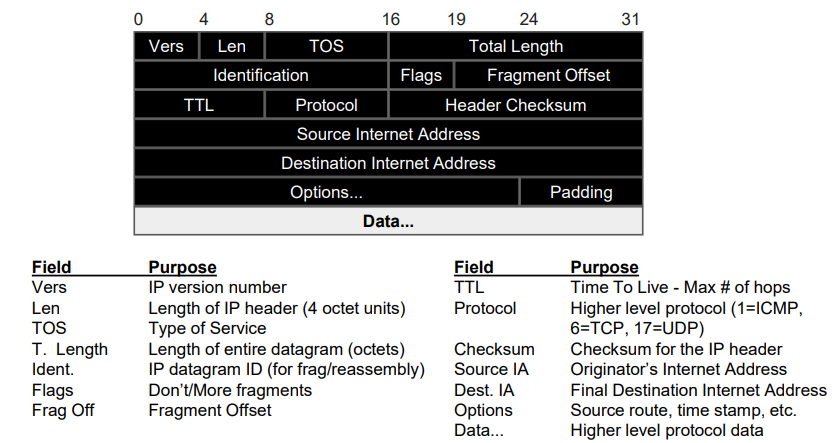
Routing
Routing table forward to the IP address of next-hop, based on target IP
Most devices send everything to a single local router (gateway)
DNS: Domain Name System ARP: Address Resolution Protocol
- Discover link layer address
Network Setup
- Static: stored in FS
- Dynamic: retrieved from DHCP (Dynamic Host Configuration Protocol)
auto eth0
iface eth0 inet dhcp
UDP
IP
- packet length + checksum
- src/dst ports
Allows multiplexing over IP
Application: can tolerate data loss (E. video, games)
TCP
Reliable, connection oriented, stream delivery
- Overheads
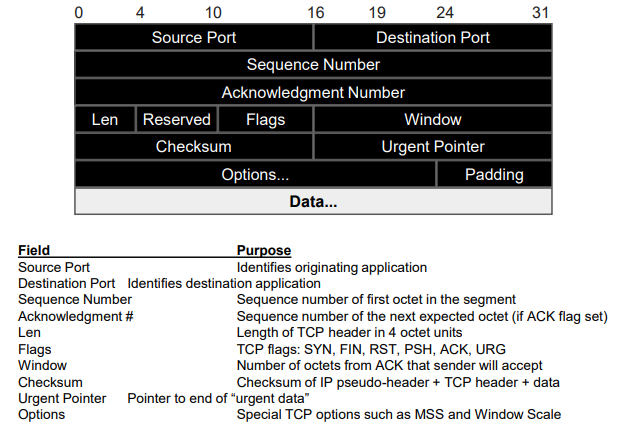
- Need buffer in sender/receiver end
- Throttle traffic on congestion
Socket
Server
// create a socket object
int socket(int domain, int type, int protocol);
// bind socket to IP address
int bind(int sockfd, const struct sockaddr *addr, socklen_t addrlen);
struct sockaddr { sa_family_t sa_family; char sa_data[14]; };

// tell OS to prepare for incoming requests, buffer to backlog
int listen(int sockfd, int backlog);
// accept connection, return new socket with connection peer info
int accept(int sockfd, struct sockaddr *restrict addr, socklen_t *restrict addrlen);
Then do read(), write() on the socket
Treated as a special inode to integrate with VFS
Transfer
Sliding window, with timeout
Congestion Control
Window size related to available BW
- Slow start (exponential)
- When timeout, reduce window size
- Additive growth, multiplicative drop
- Fast retransmit, fast recovery
Workflow
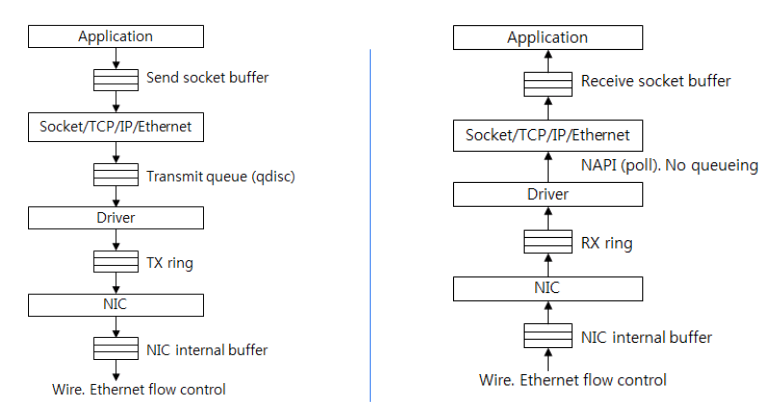 Need to limit usage, if specified through
 cgroup
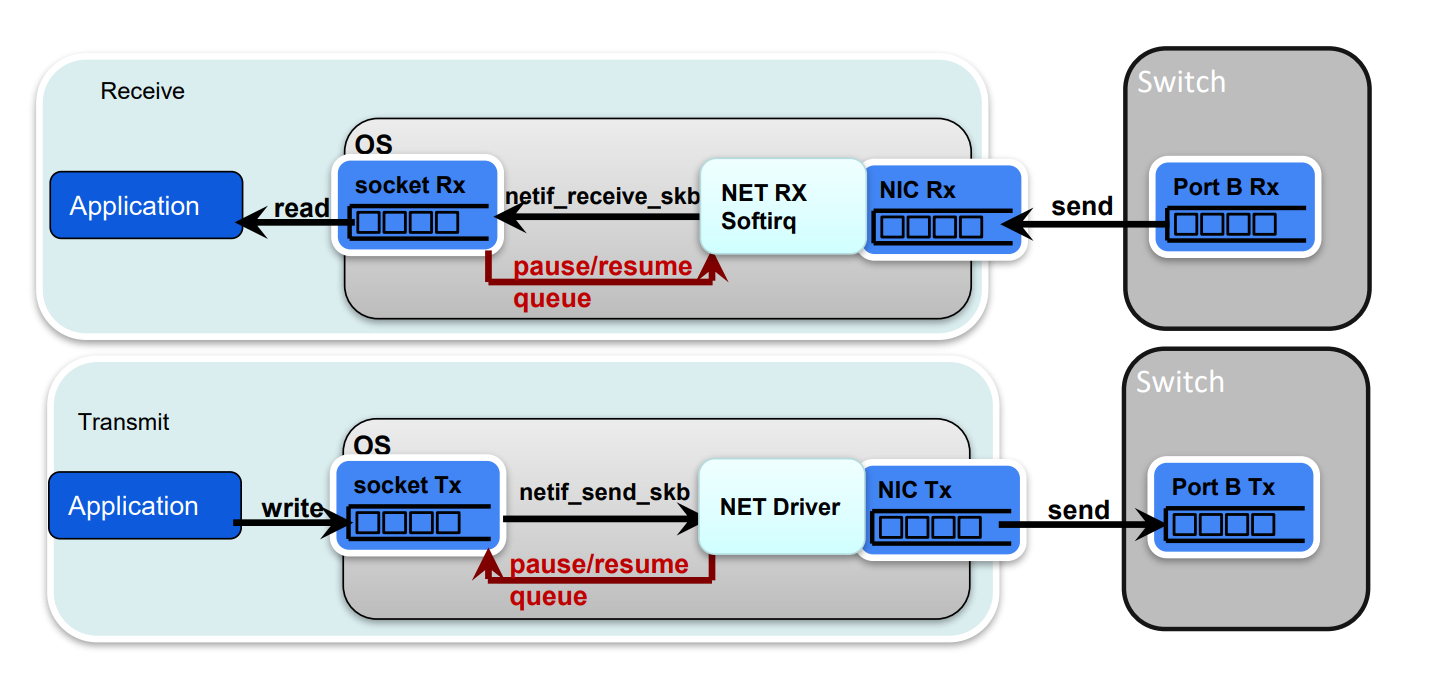 If OS buffer full, tell NET receive end to stop!
- If NET driver full, tell TCP to stop sending
TLS Security
Setup
key exchange, hashing function, etc.