
C2cpp Notes: Container and Inheritance
Published:
5. Dynamic Array
Implementation of
std::vector(templatized class)
Dynamically growable integer array (add to back)
- Allocate
sz + 1elements on the heap - When you call
push_back(), add to the provision element, andsize++
Member initializer list
Preferred, since members already constructed and initialized simultaneously
- Avoids default construct, then assignment in the body
class IntArray {
private:
	size_t sz;
	size_t cap;      // need cap declared before a
	int* a;
public:
	IntArray() : sz{0}, cap{1}, a{new int[cap]}  // member initializer list
	{
		// sz  = 0;
		// cap = 1;
		// a = new int[cap];
	}

	void push_back(int x) {
		if (sz == cap) {
			int* a2 = new int[cap * 2];   // if new fails, exits, but cap intact
			cap *= 2;                     // strong exception guarantee
			std::copy(a, a+sz, a2);       // [first, last+1), dst
			delete[] a;
			a = a2;
		}
		a[sz++] = x;
	}
	// ...
- If have capacity, put the next element (\(O(1)\))
- If not, allocate double the capacity, copy over, and add (\(O(n)\))
- Overall complexity: \(O(2n) = O(n)\) for \(n\) elements
- Average: amortized \(O(1)\)
Strong exception guarantee
If an exception happens in the middle, it won’t mess up your object
Not planning to use copy constructor and copy assignment, so use delete
- Undefine the compiler generated one
- Copy attempts will fail to compile
- Use
defaultfor compiler generated
	// ...
	~IntArray() {
		delete[] a;
	}

	IntArray(const IntArray&) = delete;
	IntArray& operator=(const IntArray&) = delete;

	int& operator[](int i) { return a[i]; }
	const int& operator[](int i) const { return a[i]; }

	size_t size() const { return sz; }
	size_t capacity() const { return cap; }
};
Usage:
int main() {
	using namespace std;
	IntArray ia;
	for (int i = 0; i < 20; i++) {
		ia.push_back(i);
		cout << ia << endl;
	}
}
6. Move Operation
Continuation of 2. Basic 4
Motivation
Construct a local array and return by value
- Will invoke 2 copy constructions
IntArray createIntArray() {
	IntArray tmp;
	for (int i = 0; i < 20; i++) {
		tmp.push_back(i);
		std::cout << tmp << std::endl;
	}
	return tmp;   // copy by value
}

int main() {
	IntArray ia { createIntArray() };  // make another copy
}
Fail to compile
Earlier,deleted the copy constructor!
It’s very cumbersome to return an object by value by copying!
- Want to pass a reference, and allocate the structure outside the function
void createIntArray(IntArray* ia_ptr) {
	for (int i = 0; i < 20; i++) {
		ia_ptr->push_back(i);
		std::cout << *ia_ptr << std::endl;
	}
}

int main() {
	IntArray ia;    // allocate locally on the stack
	createIntArray(&ia);
}
Move Constructor
Move constructor only kicks in when assigning to a temporary object that will go away
- More efficient than copy
- Do a shallow copy of each element from
tmpto the new objectthis - Sever the connection to the original pointer
.a
IntArray(IntArray&& tmp) : sz{tmp.sz}, cap{tmp.cap}, a{tmp.a} {
	tmp.sz = tmp.cap = 0;
	tmp.a = nullptr;
	std::cout << "move ctor" << std::endl;
}
Instead of making a deep copy of original
tmp, “steals” whattmpused to have, and move to the return
Now, when tmp -> unnamed return -> ia, each old object gets destroyed
- Instead of making a brand object and making a copy, steal the internals
- Two copies becomes two movements
- Old object gets destroyed, and
delete nullptris okay
Move constructor can be elided as well
&& rvalue Reference
Will be on exam
- Regular variables are lvalue
int i = 5,ican be on the LHS, lvalue5can’t be lvalue, can’t do5 = i
MyString{"xyz"}is rvalue
struct X {
	X() : d{100} {}   // set X.d to 100
	double d;
};

void f1(X& t)       { t.d *= 2;  cout << t.d << endl; }

void f2(const X& t) { cout << "can't change t" << endl; }

void f3(X&& t)      { t.d *= 3;  cout << t.d << endl; }

int main() {
	X x;           // x is an lvalue
	f1(x);         // passing an lvalue to X&       --> ok
	f2(x);         // passing an lvalue to const X& --> ok
	f3(x);         // passing an lvalue to X&&      --> not ok

	// X{} creates a temp object (rvalue)
	f1( X{} );     // passing an rvalue to X&       --> not ok
	f2( X{} );     // passing an rvalue to const X& --> ok
	f3( X{} );     // passing an rvalue to X&&      --> ok
}
- Copy constructor take
constreference, since old object not modified - Move operator take rvalue reference to bind to rvalue
- Only allow stealing from temporary objects
- Not named!!!
Move Assignment
IntArray& operator=(IntArray&& tmp) {
	if (this != &tmp) {
		delete[] a;

		sz = tmp.sz;
		cap = tmp.cap;
		a = tmp.a;

		tmp.sz = tmp.cap = 0;
		tmp.a = nullptr;
	}
	std::cout << "move assignment" << std::endl;
	return *this;
}
Usage
IntArray ia = { createIntArray() }
IntArray ia2;
ia2 = ia;        // we don't have copy assignment,
Won’t work since ia is an lvalue, not allowed to move!!
Need to cast to force a move assignment
ia2 = (IntArray&&) ia;     // not recommended
// or
ia2 = std::move(ia);
Original ia loses its content
Summary
Compiler can generate a move constructor and move assignment
There are some edge cases for that
- When no destructor, copy constructor, or copy assignment declared
- Compatibility with copy rules, if legacy code write copy but not move
- Move will fall back to copy
- rvalues can be bound to
constlvalues
- rvalues can be bound to
- Member-wise move
- If either move constructor or move assignments are declared, compiler will implicitly delete the copy constructor and copy assignment
Rule of 5
If you declare any of destructor/copy/move (includingdefaultanddelete), very likely need to declare all of them
Rule of 0
If all class members already have their 5 defined correctly (E. library class), and your class has no special resource management, no need to declare in your class
- Some prefer to declare with
=default
7. vec Class
template <typename T>- Change
inttoT - Make functions template functions parameterized by
T
template <typename T>
std::ostream& operator<<(std::ostream& os, const vec<T>& ia);

Vec<int> CreateIntVec() {
	Vec<int> tmp;       // need to explicitly specify the type
	// ...
}
void push_back(int x) {
	if (sz == cap) {
		int* a2 = new int[cap * 2];
		cap *= 2;
		std::copy(a, a+sz, a2);   // uses copy assignment
		delete[] a;
		a = a2;
	}
	a[sz++] = x;
}

int main() {
	Vec<MyString> v;    // (1)
	v.push_back("abc"); // (2)
	v.push_back("def"); // (3)
	MyString s{"xyz"};  // (4)
	v.push_back(s);     // (5)
}
- Constructs
von the stack{size_t size, size_t cap, MyString a[1]}sz = 0; cap = 1;ais an allocated 1-element array- Calls
MyString()- Makes a default
MyStringobject on the heap, with
- Makes a default
- Calls
const T&requires a promoted temporary object- Temp (rvalue)
MyString("abc")object constructed on stacklen = 3data = "abc\0"
- Temp comes into
push_back()asconst T& x(reference)- Must have
const, else won’t accept rvalue
- Must have
a[sz++] = x- Copy assignment
xdestroyed afterpush_back()return, and temp
- Temp (rvalue)
push_back("def")- Same temp creation
- Allocation needed! (two levels)
new MyString[2]allocated on heap- Both members are default constructed
MyString()
- Both members are default constructed
std::copy()- Copy assignment
deleteold data- Data pointer updated
- Copy assignment
delete[] adelete[]all string allocations
x(and its members) gets copy assigned to itsa[1], and destroyed
MyString s{"xyz"}screated on stack"xyz\0"on heap
v.push_back(s)spassed by reference- Need to reallocate again
- Every
MyStringgets default constructed - Copy assign the
MyStrings over - The vector entry
v.a[3].datahas a different copy withs.data- Last slot left “empty”, but aMyStringobject
- Every
STL containers hold its own copy of the data (by value)
This is NOT how
vectorworks. Default construction is wasteful!
std::vectorwill not initialize the memory (no default constructornew, justmalloc())
- But how would
a[sz++] = xwork?
- This is an assignment. The LHS object must be constructed
- Solution: Placement
new
Placement new
char s_buf[sizeof(MyString)];
MyString* sp = new (s_buf) MyString{"hello"};
Casting decouples memory allocation and constructor call!
- No memory allocation
- Only calls constructor Can’t directly invoke
delete, need to manually invoke the destructorsp->~MyString();
Strong Exception Guarantee
For push_back(Int), exception can only happen in new. std::copy() of integers is trivial
- Need to guarantee that
IntArraywon’t be changed
For push_back(MyString),
- If
newthrows, nothing created - If
copy()throws,operator=(MyString)usesnew, may throw
- Assignment
a[sz++] = xmay throw
void push_back(const T& x) {
	if (sz == cap) {
		T* a2 = new T[cap * 2];       // no issue
		try {
			std::copy(a, a+sz, a2);
		} catch (...) {               // catch any exception
			delete[] a2;              // cleanup before throw
			throw;
		}
		cap *= 2;
		delete[] a;
		a = a2;
	}
	a[sz] = x;          // if throw here, all did was increasing cap
	sz++;               // separate sz++
}
Still issues!
Ona[sz] = x,operator=(MyString)may leave the default constructor in a bad state - Assume if copy assignment fails, it still leaves a valid object there
Might be more efficient if the elements are moved, rather than copy
std::vectortries to move elements during reallocation, but
- Move may not easy to roll back on exception
std::vector uses the criteria:
- Moved if move constructor marked
noexcept - Copy else
- If copy constructor deleted, then fall back to move (forgo strong exception guarantee)
8. Inheritance
Not too useful in cpp, mostly on template and OOP mechanisms
Base class -> derived class
- Derived classes need to be constructed, if its base class constructor takes arguments
class B {
public:
	uint64_t sum() const { return b; }

// protected
private:
	uint64_t b = 100;
};

class D : public B {
public:
	// return b + d;
	uint64_t sum() const { return B::sum() + d; }

private:
	uint64_t d = 200;
};
D has the derived sum() from B, and its own version
Don’t forget
public!
Scope:
privatemembers can’t be accessed by derived classes. NeedB::sum()protectedmembers are accessible, but not to general outside
sizeof(D) is 16 bytes,
- 8 for
.b = 100(inherited) - 8 for
.d = 200
Can cast to find it:
uint64_t* p = (uint64_t*) &x;
uint64_t*p = reinterpret_cast<uint64_t*>(&x);
Static Binding
By default how cpp works, translated to C
x is a D object, but the compiler picks the function to invoke based on the object type
int main() {
	using namespace std;

	D x;
	w( x.sum() );

	B *pb = &x;
	D *pd = &x;
	w( pb );
	w( pd );
	w( pb->sum() );    // compiler generates B_sum(pb)
	w( pd->sum() );    // compiler generates D_sum(pb)
}
Dynamic Binding
Java behavior: call the underlying object type, not pointer type
Use keyword virtual in base class
- Optionally
overridein derived class
class B {
public:
	virtual uint64_t sum() const { return b; }
}

// not required
class D : public B {
public:
	uint64_t sum() const override { return B::sum() + d; }
}
How did compiler know that
pbis pointing to aDobject?
What if in a different cpp file that hasfoo(B* pb) { pb-> sum();}Anypbderived fromBcan be called here
- Without
virtual, compiler will translate everything toB_sum- How does
virtualwork?
Now, sizeof(x) = 24, object gets elongated
.vptris some address- Virtual Table Pointer, array of function pointers for each virtual function in the class
- One table for class
- For
D, one entry:D::sum()
- Virtual Table Pointer, array of function pointers for each virtual function in the class
.b = 100.d = 200
If a B object instantiated,
.vptrwill point to a different V table forBclassB::sum()
When pb -> sum();
D::sum()is always called, regardless the pointer type ofpb- When declared,
pbis pointing to the vtable ofD - Directly invoke
D::sum()from the vtable pointer entry - Compiler generates
pb->vptr[0] (pb)- Call
sum()by passingpb
- Call
Even if ptr is B type, B::sum() invoked through B’s vtable
Virtual Table
Manually invoke sum() manually
sumhas typeuint64_t (const D*)- vtable entry
uint64_t (const D*) - vtable pointer in
D xhas typeuint64_t (**) (const D*) B* pbhas typeuint64_t (***) (const D*)Reference 3 times, and deref twice
D x;
B* pb = &x;
(uint64_t (***) (const D*)) pb )[0][0](&x);
Multiple Inheritance
CPP class can derive from multiple base classes (not used much)
- Can’t do java. Only can memberless classes: interface
// similar class C
class D: public B, public C {
public:
	uint64_t sum() const { return B::sum() + C::sum() + d; }
private:
	uint64_t d = 200;
};
With static binding, initialize B and B*, C*, D*,
B*, D*point to the beginningC*point to theCportion, a different pointer!- When assign
C* pc = &x;, compiler silently changes the pointer - Since the base portion of
Cis in the middle
- When assign
static_cast
Downcast base pointer C* back to the original object pointer D*
- Opposite of
C* pc = &x;(upcast) - with
static_cast
	D* pd2 = static_cast<D*> (pc);    // cast C* to D*
	w( pc );
	w( pd2 );
Different pointers are printed
Not perfect
C y;
pd2 = static_cast<D*> (&y);     // compiler allowed
pd2->sum();                     // crash
yhas typeC, bad* pd2has typeD, originally, OK
Multiple Virtual Inheritance
- Add
virtualto base classesB::sum()andC::sum() - Add
overridetoD::sum()
 Now,
Now, sizeof(x) = 40 (5 slots)
- Without
virtual, was24, with.b, .c, .dTwo vtable pointers, to different places of the same vtable [0] .vptr1[1] .b = 100[2] .vptr2[3] .c = 150[4] .d = 200- 01:
Bportion - 23:
Cportion
D x;
C* pc = &x;
pc->sum();      // calls C portion, D[2], and invoke D::sum();
- When calling from
C,thisis not pointing to the beginning of the object - Need to adjust
thisby subtractingsizeof(B)
Translated to the C version in the object file:
uint64_t thunk_of_D_sum(const C* this_ptr) {
	char* adjusted_this_ptr = (char*)this_ptr - sizeof(B);  // B portion size
	return D::sum( (const D*)adjusted_this_ptr );           // actual this
}
dynamic_cast
In vtable, there are information for crosscast and downcast with more checking
- Point to global
std::type_info(1 per class)
At compile, still checks
- Inputs needs to be pointers
- Classes have
virtualfunctions, so vtable can be accessed.
D x;
B* pb = &x;
C* pc = &x;
D* pd = &x;
assert(dynamic_cast<B*>(pc) == pb);    // cross cast C (actual D) to B
assert(dynamic_cast<D*>(pc) == pd);    // down cast  C (actual D) to D
C y;
C* pc2 = &y;
assert(dynamic_cast<B*>(pc2) == nullptr);  // fails, can't cast (actual) C to B
assert(dynamic_cast<D*>(pc2) == nullptr);  // fails, can't upcast C to D
Virtual Inheritance
Diamond Problem
class A {
public:
	virtual uint64_t sum() const { return a; }
private:
	uint64_t a = 5;
};

class B : public A {
public:
	virtual uint64_t sum() const { return b; }
private:
	uint64_t b = 100;
};

class C : public A {
public:
	virtual uint64_t sum() const { return c; }
private:
	uint64_t c = 150;
};

class D : public B, public C {
public:
	uint64_t sum() const override { return B::sum() + C::sum() + d; }
	// A::sum() is ambiguous and does not compile:
	// uint64_t sum() const override { return A::sum() + B::sum() + C::sum() + d; }
private:
	uint64_t d = 200;
};
D is derived from both B and C, which is derived in D
D x;
A* pa = &x;    // compilation error!
- Can’t
static_castordynamic_castto(D*)either
Diamond Problem
Compiler won’t know whichAportion to point to!
A::sum()can’t be called inDeither!

Solution
Derive classes B, C virtual from A
- Eliminates duplication of
A
class B : virtual public A {
	// ...
};
Now all will compile properly and sum 455:
	D x;

	A* pa = &x;
	B* pb = &x;
	C* pc = &x;
	D* pd = &x;
	w( pa );           // 0de8, off=40 (16+24)
	w( pb );           // 0dc0
	w( pc );           // 0dd0, off=16
	w( pd );           // 0dc0
	w( pa->sum() );
	w( pb->sum() );
	w( pc->sum() );
	w( pd->sum() );    // all 455
Will no longer copy A in each B C instance. Put it at the end
In vtable, new vbase_offset, vcall_offset 
Misc
Construction Order
Sock and shoes (opposite for destruction)
- Base class constructed
- All members constructed
- Derived class itself constructed
Virtual Function & Abstract Class
Abstract class have purely virtual function
- aka interface in Java
virtual uint64_t sum() const = 0;No code, meant purely to be overridden by derived classes
- The class itself cannot be instantiated
- Only its derived classes that overrides this method can
Virtual Destructor
int main() {
	B* pb = new D;
	delete pb;      // only destructor of B called
}
The destructor is not virtual, (static binding), so the B destructor will be invoked
Need to virtual the destructor
struct B {
	virtual ~B() { cout << "B::~B()" << endl; }
};

struct D : public B {
	~D() override { cout << "D::~D()" << endl; }
};
All members, D, M, B, will be destroyed properly
9. iostream
int sum_ints(std::istream& is) {
	int i, sum = 0;
	while (is >> i) {      // extract a number to int i
		sum += i;
		std::cout << "current sum: " << std::setw(4) << sum;// 4 space, right align
		print_io_states(is);
	}
	return sum;
}
Keeps printing the sum and stats
echo "5 7 9 " | ./io1
istream
while (is >> i);

istream& istream::operator>>(int& value);     // modifies istream (this)
ios::operator bool() const;
// same as !ios::fail
- Return
istreamso can keep chaining things operator <type>is a conversion operation- Invoked when
<type>is required
- Invoked when
iosis a base class ofistreamstd::setw()is a function that returns an objectWidthManipulatorostream& operator<<(ostream& os, const WidthManipulator& wm) { os.width(wm.get_width()); return os; }
Hierarchy
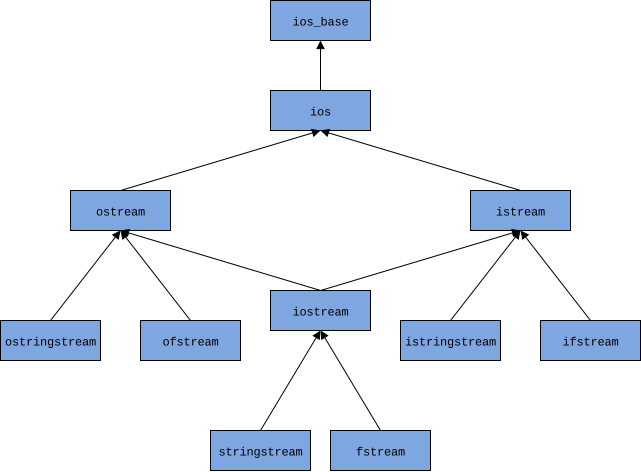
std::coutandstd::cinare instances ofostreamandistreamostringstreamprints into a stringofstreamprints into a file
iostate
Top level
ios_basecontains flags and constants, such asios_base::iostate
iostate is a set of flags telling the state of the IO, can be combined
failbit: formatting/extraction error/EOFbadbit: irrecoverable error (E. disk crashed)eofbit
In class ios, flags can be accessed by:
fail()(failbitORbadbit)operator bool()same as!fail()
bad()eof()echo "10 2 3 4" | ./io1Only after summing
4, and trying to read for one more time, hits EOFechoadds a\nat the end of “4”.ioshits the\nfirst and parses the 4 okay
Now suppress \n by echo -n
echo -n "10 2 3 4" | ./io1
- Now, when summing “4”,
eof()set, since hit EOF directly after “4”fail() = 0,eof() = 1is >> istill evaluated to1, so loop executes one more time
- Last time,
fail() = 1,eof() = 1(still)
Error Recovery
Keep recovering until eof()
int sum_ints(std::istream& is) {
	int i, sum = 0;
	while (!is.eof()) {
		is >> i;      // skip all leading whitespaces

		if (is.bad()) {
			throw std::runtime_error{"bad istream"};
		}

		else if (is.fail()) {    // fail(), but not bad()
			if (is.eof()) {
				// failbit && eofbit: this is normal (trailing whitespace)
				break;
			}
			// failbit && !eofbit: probably non-digit; just skip it
			is.clear();
			char c;
			is.get(c);  // consume a single char
			std::cout << "  skipped: " << c << '\n';
		}

		else {    // read i successfully;
			// we could have hit eof or not (depends on trailing whitespace)
			sum += i;
			std::cout << "current sum: " << std::setw(4) << sum;
			print_io_states(is);
		}
	}
	return sum;
}
- If get
char, consume one character at a time - If get
int, consume a chunk
C vs Cpp
By default: std::cin is sync with stdin, and for out and err
- Cpp streams are unbuffered
- Each IO operation on cpp stream is immediately applied to the corresponding C stream’s buffer
- Underneath, call the C functions (E.
printf(),scanf())- Thin wrapper
Can detach Cpp stream from C stream, automatically add its own buffer:
std::ios_base::sync_with_stdio(false);
- Cpp streams are allowed to buffer its IO independently
- Lose the following:
- No longer thread-safe
- No
\nmay not flushstdoutto terminal- Use
'\n'instead ofstd::endlfor terminal output
- Use
- No longer thread-safe
Polymorphic ios
pair<T1, T2> is a library template with two types
void f1(istream& is) {
	while (!is.eof()) {
		is >> std::ws;          // discard leading whitespace
		if (!is || is.eof())    // break if nothing else
			break;

		pair<string,double> e;
		is >> e;                // overload >> to read from istream

		if (is.fail())
			break;
		cout << e << '\n';
	}

	if (is.bad())
		throw runtime_error{"bad istream"};
	else if (is.fail())      // fail but not just eof
		throw invalid_argument{"bad grade format"};
}

int main(int argc, char **argv) {
	try {
		f1(cin);
	} catch (const exception& x) {
		cerr << x.what() << '\n';
	}
}
Now parse pair from istream:
std::istream& getline(std::istream& is, std::string& str, char delim);

static istream& operator>>(istream& is, pair<string,double>& e) {
	char c;
	// 1. read opening quote, skipping whitespace
	if (is >> c && c == '"') {
		string student;
		// 2. read all chars into student, stop at closing quote, then discard it
		if (std::getline(is, student, '"')) {
			// 3. read a comma, skipping whitespace
			if (is >> c && c == ',') {
				double grade;
				// 4. read double grade
				if (is >> grade) {
					e = make_pair(student, grade);
					return is;
				}
			}
		}
	}
	// if fall here, fail :(
	is.setstate(ios_base::failbit);
	return is;
}

static ostream& operator<<(ostream& os, const pair<string,double>& e) {
	return os << "[" << e.first << "] (" << e.second << ")";
}
make_pair()
String Stream
Issue with f1(): one failed record failed will fail break and throw
- Want recover and move on
f2() adds another layer of buffer
- Read an entire line
- Construct
istringstreamobject from the line, as backup - Call
f1(iss)issbecomes theistreamsource off1(), instead ofcin- If error, print
void f2(istream& is) {
	string str;

	while (std::getline(is, str)) {
		istringstream iss(str);

		try {
			f1(iss);
		} catch (const invalid_argument& x) {
			cerr << x.what() << ": " << str << '\n';
		}
	}
}
File Stream
f3() constructs ifstream object
void f3(const char* filename) {
	ifstream ifs { filename };
	if (!ifs) {
		if (filename != nullptr)
			throw runtime_error{"can't open file: "s + filename};
		else
			throw runtime_error{"no file name provided"};
	}
	f2(ifs);
}
10. Sequence Containers
Standard Template Library (STL)
Array
int a[2] = {6, 7};
int a[2] {6, 7};              // preferred in cpp
Now wrap C array in class template Array
template <typename T, size_t N>
struct Array {
	// typedef T value_type;
	using value_type = T;
	// T(&)[N] is a reference to array of N elements of type T
	using TA = T(&)[N];

	T& operator[](int i) { return a[i]; }
	const T& operator[](int i) const { return a[i]; }

	// member function, done in compile time
	constexpr int size() const { return N; }
	TA underlying() { return a; }

	T a[N];
};
usingdeclaration: another way to dotypedef. Define newvalue_typemeansTTAreferences to the array
constexprcan be designated to any (member) function. Tells compiler that such call can be evaluated at compile timeunderlying()pass out the reference to the entire array- Avoids decaying array into a pointer, by using
T(&)[N]
- Avoids decaying array into a pointer, by using
int *p = a;
// pa is a pointer to an array of 5 ints and points to the array a
int (*pa)[5] = &a;
// ra is a reference to an array of 5 ints and refers to the array a
int (&ra)[5] = a;
pais a pointer. After dereferencingpa, you will getint[5]
pahas typeint (*)[5]pasame value asa, but different typepa + 1will point to 5 elements after
	Array<int,5> v { 100, 101, 102, 103, 104 };
	constexpr size_t n = sizeof(v.underlying()) /
							sizeof(decltype(v)::value_type);
						 // sizeof(Array<int,5>::value_type);
	static_assert(v.size() == n);
decltype()to get type of a variable
std::array
Same fixed size
	std::array<int,5> v { 100, 101, 102, 103, 104 };
	for (size_t i = 0; i < v.size(); ++i)  { print_int(v[i]); }
std::vector
Initialization similar to array
- Also guarantees elements are contiguous
push_back()may invalidate pointers and refs!
	std::vector<int> v { 100, 101, 102, 103, 104 };
	v.push_back(105);
	for (size_t i = 0; i < v.size(); ++i)  { print_int(v[i]); }
Can use directly list-initialization. The compiler can deduce type T
std::vector v { 100, 101, 102, 103, 104 };
std::deque
Double-ended queue
- Vector with
push_front()in $O(1)$,- vs vector $O(n)$ (must shift everything)
- Existing elements never move, pointer and refs are preserved on pushing front/back
- Not preserved if
insert()ordelete()in the middle :(
- Not preserved if
- No contiguity guarantee
- Chunks (still good cache locality)
- Slower access
  deque<int> v { 100, 101, 102, 103, 104 };
  v.push_front(99);
  v.push_back(105);
Implementation
Deque maintains a chunk pointer array
- Allocate a new chunk if needed
- Allocate new chunk pointer array, same as vector

std::list
Doubly linked list
	list<int> v { 100, 101, 102, 103, 104 };
	v.push_front(99);
	v.push_back(105);
	while (!v.empty())  {
		print_int(v.front());
		v.pop_front();
	}
No operator[]()!!! Need to traverse yourself
- Avoid providing an inefficient version
Push and insert() all in \(O(1)\)
- Slower than vector in practice
std::forward_list
Minimal singly linked list
- Just
push_front()forward_list<int> v { 100, 101, 102, 103, 104 }; v.push_front(99); while (!v.empty()) { print_int(v.front()); v.pop_front(); }
sizeof(forward_list<int>) = 8
- Header is 8 bytes (single head pointer)
- Middle nodes will have size 12.