
Out-of-Order Rename Core
Published:
The rename and scheduling back end of a 4-wide out-of-order processor, written in SystemVerilog and synthesized in Cadence Genus
Overview
- 4-wide dispatch, issue, and retire
- 32 architectural / 256 physical registers
- 128-entry reorder buffer, 64-entry issue queue
- Branch recovery with 8 specRAT checkpoints, single-cycle restore
- 61.9 MHz, 0.505 mm² at the default sizing
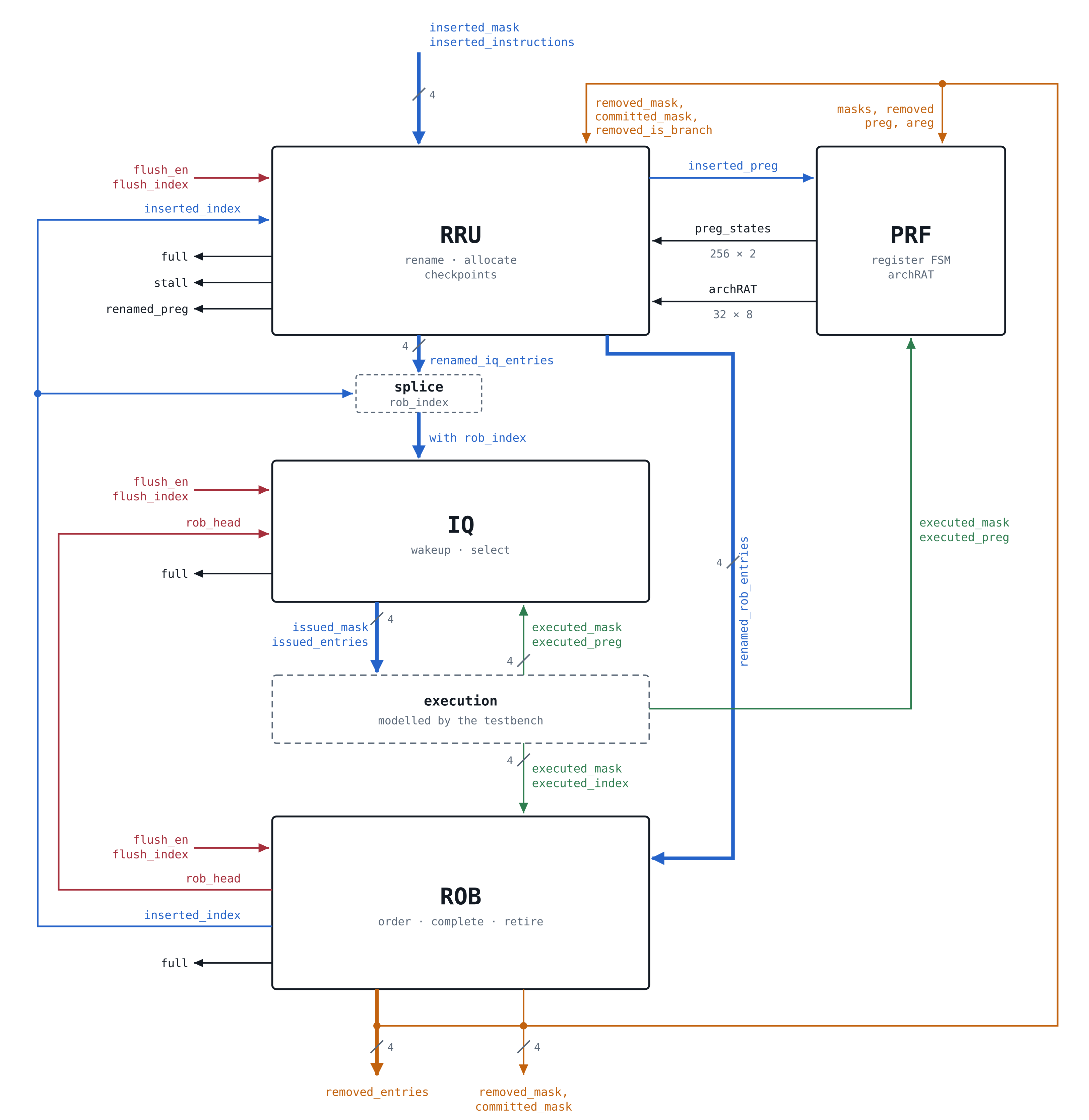
Four modules work together: the RRU renames and allocates, the IQ schedules, the ROB keeps program order, and the PRF tracks every physical register’s state
Modules
Register Renaming Unit (RRU)
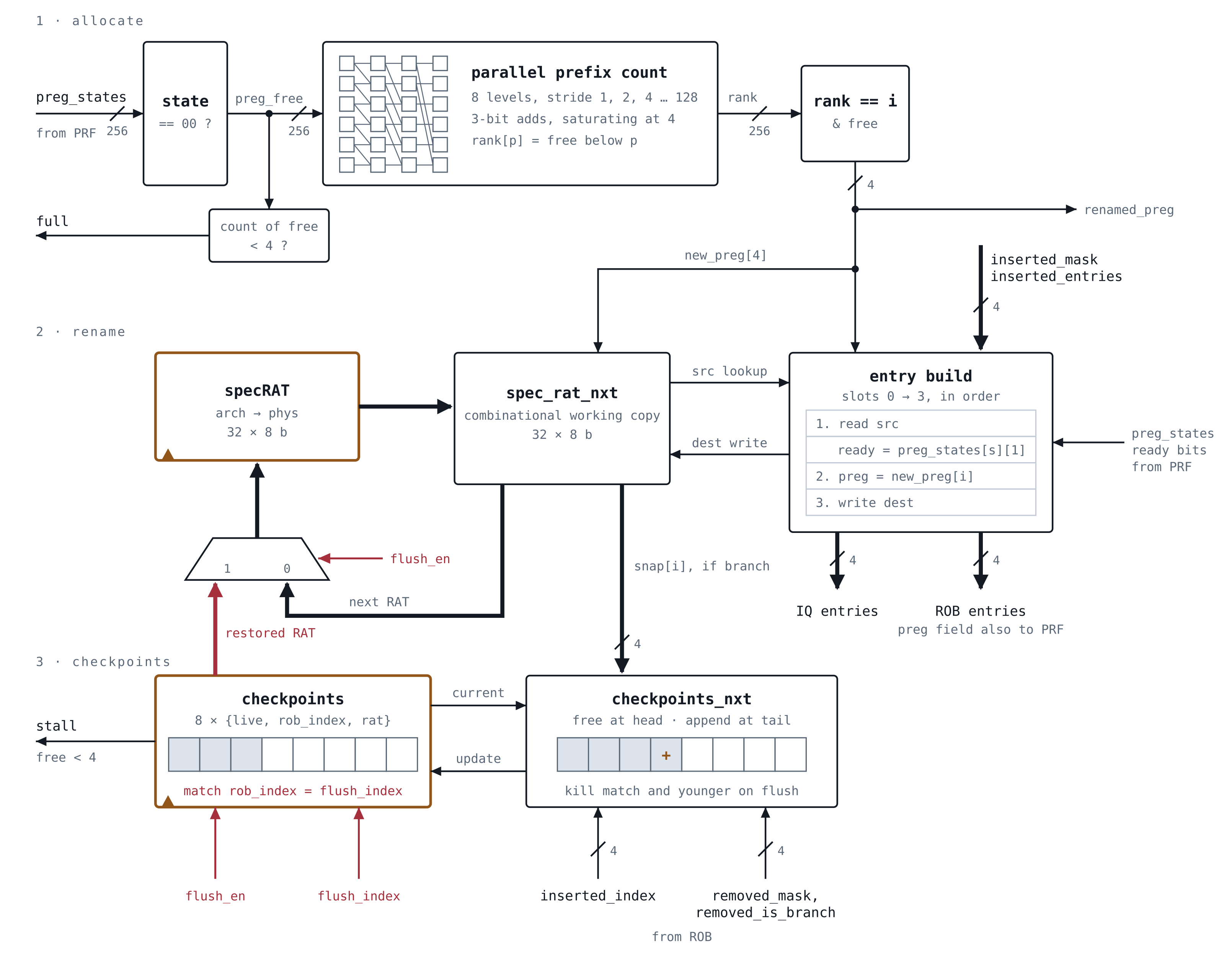
Maps architectural registers to physical registers and removes false dependencies
- Allocate: picks 4 free physical registers at once with a parallel prefix count over the PRF states
- Rename: slots 0–3 rename in order through a working copy of the specRAT, so younger instructions in a batch see older ones’ new mappings
- Checkpoints: snapshots the specRAT at every branch, and restores it in one cycle on a mispredict
Issue Queue (IQ)
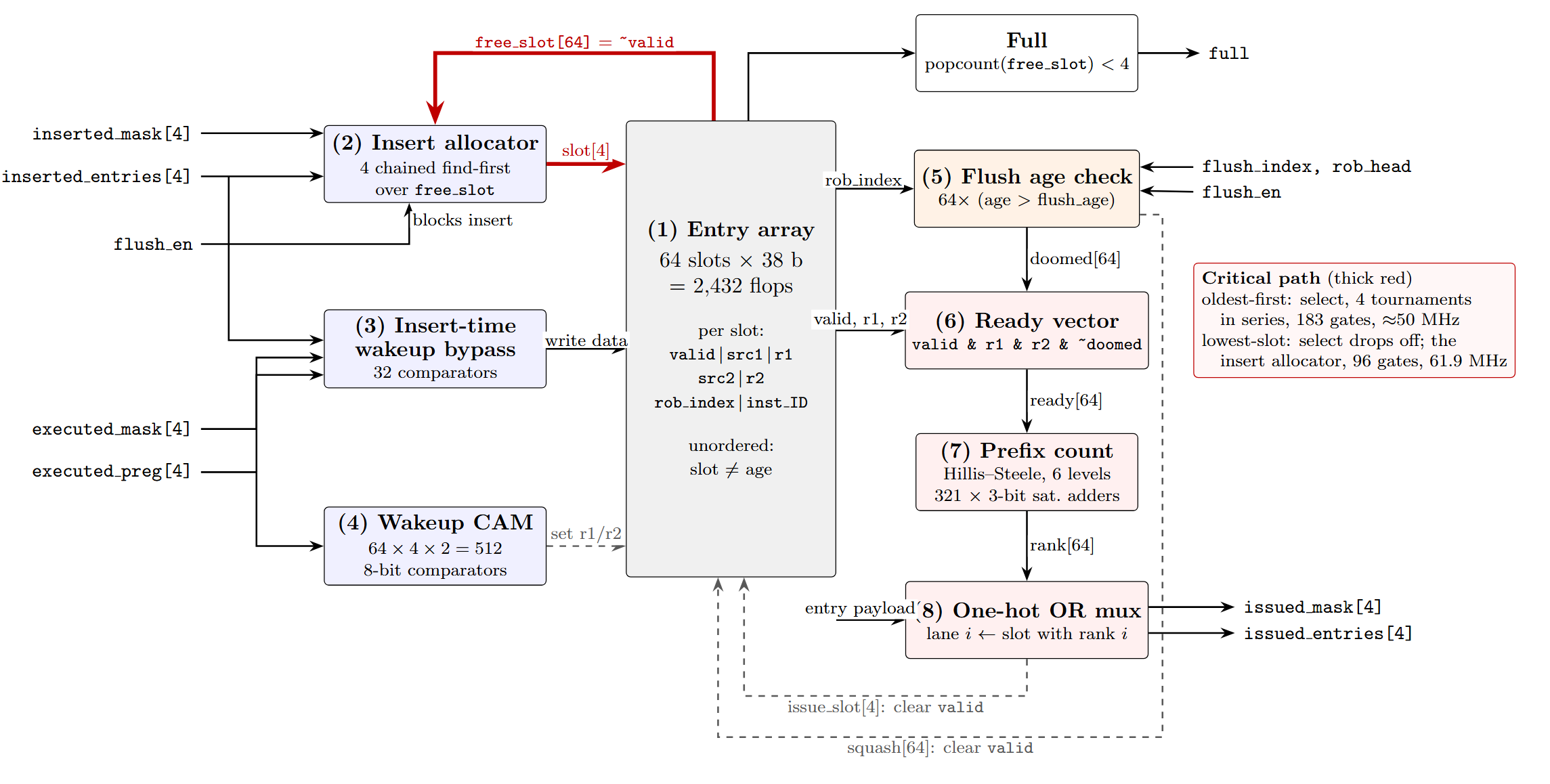
Holds renamed instructions until their operands are ready
- Wakeup: every entry snoops the execution broadcasts, including the cycle it is inserted
- Select: lowest ready slot first, ranked by a prefix count with no age comparators
- 24% faster and 35% smaller than oldest-first, for under 0.1% more cycles across the traces
Reorder Buffer (ROB)
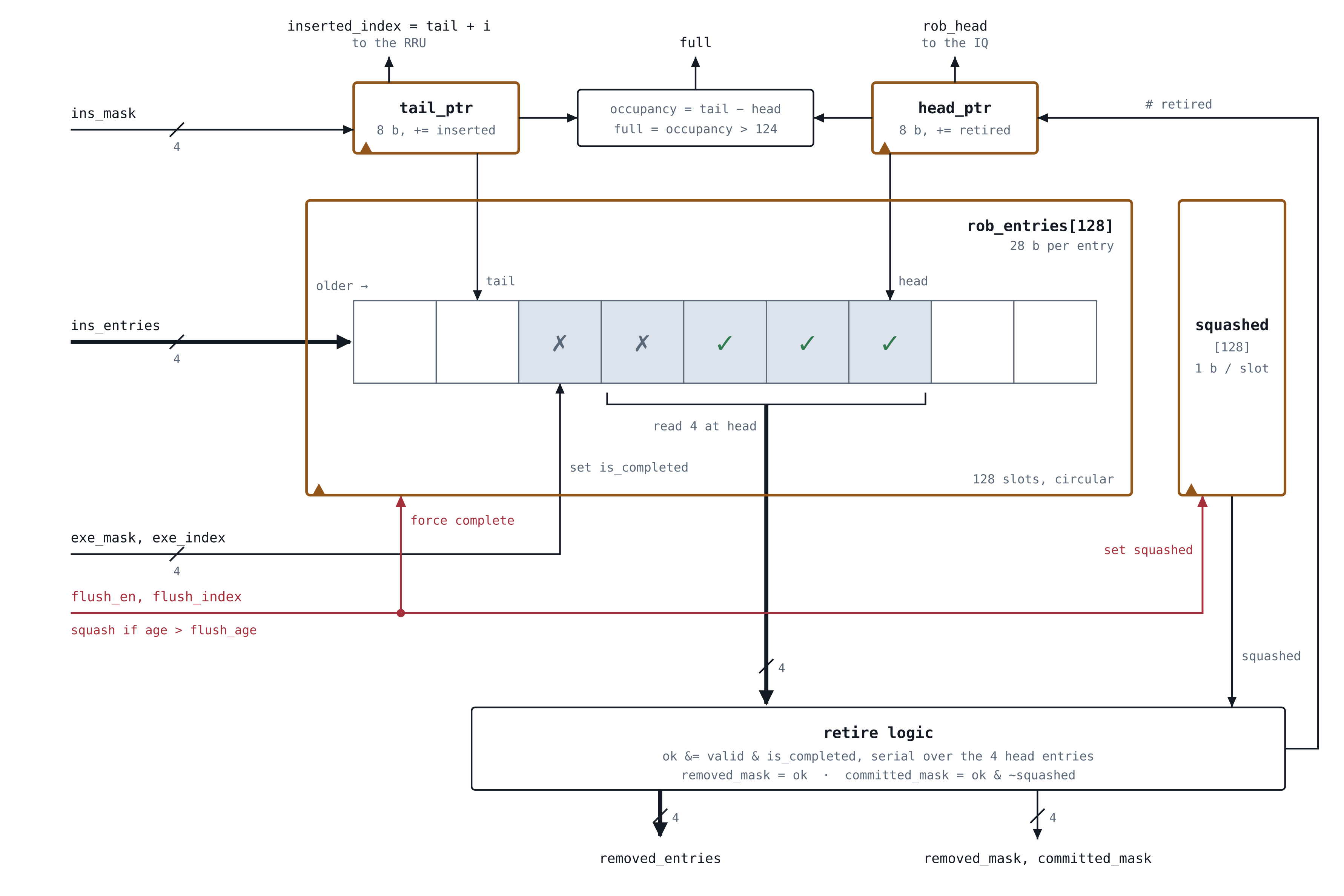
A 128-entry circular buffer that retires instructions in program order
- Retires up to 4 completed entries per cycle from the head
- On a mispredict, younger entries are marked squashed and drain through the normal retire path, freeing their registers without committing
Physical Register File (PRF)
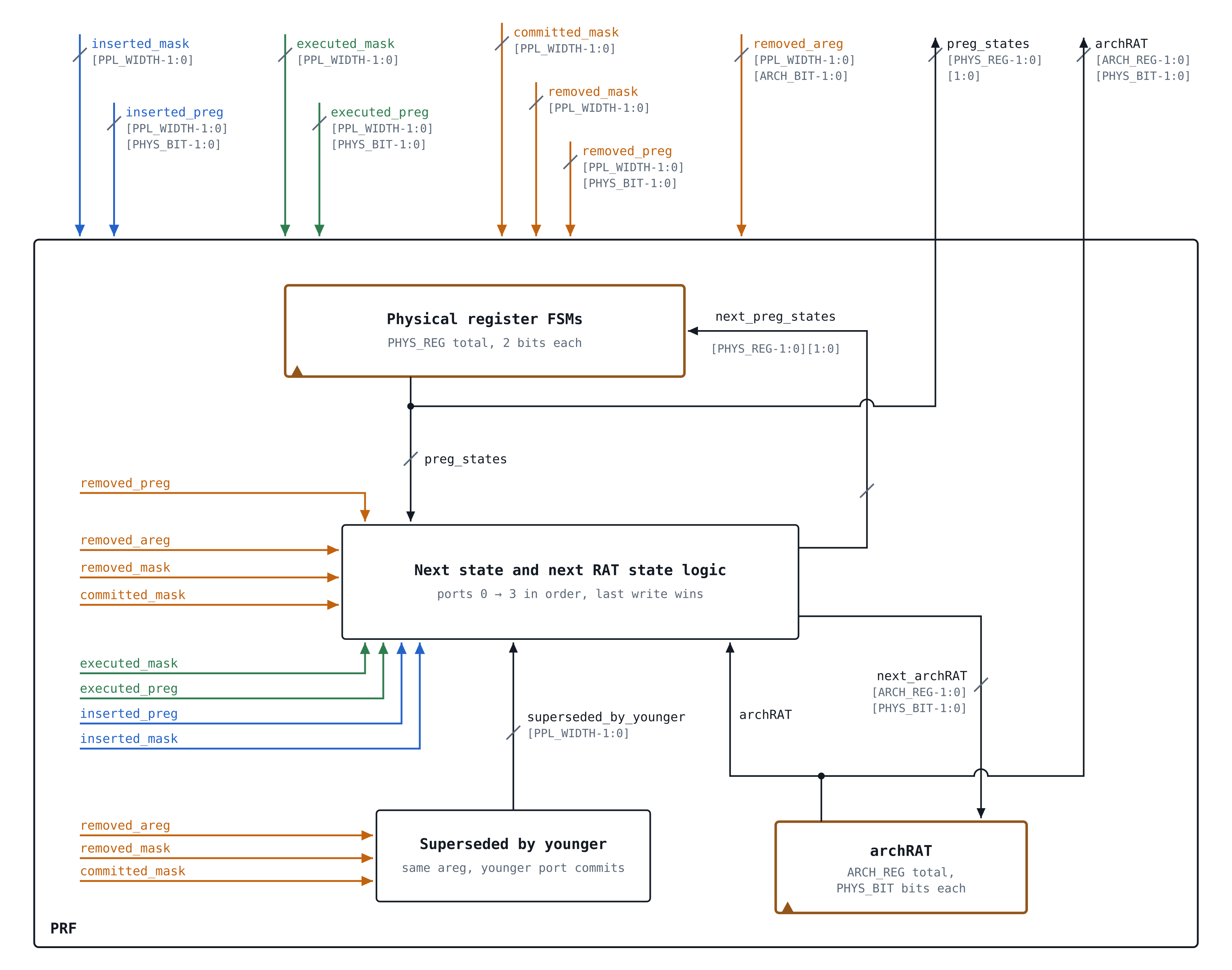
A unified register file: speculative and architectural values live together, told apart by the specRAT and archRAT
- Each register is a small FSM: Available → Renamed → Valid → Architectural
- No separate free list: the RRU allocates directly from the state array
- Commit only updates mappings, never moves data
Leaderboard Version
A separate, tuned variant for the class leaderboard, where we placed #1 in area and #3 in frequency (group phwright)
Frequency Optimizations
- Allocation one cycle ahead: the RRU computes the next free registers in advance and stores them in flops, taking the allocator off the rename path. The candidates are kept as one-hot vectors, so no decoder is needed
- Early ready bits: source ready bits no longer wait for the allocator; the RRU applies that cycle’s completion broadcasts itself
- One-hot ROB head pointer
- Displaced register in the ROB: each entry carries the register it overwrites, so the PRF no longer looks up the archRAT at commit
- Parallel PRF next state across all ports
- Cheaper flush check: the IQ’s “younger than the flushing branch” test uses three compares instead of a subtraction per entry
- Circular checkpoint buffer instead of shifting every checkpoint on each retire
Area Optimizations
- Banking by slot mod 4 for IQ, RRU, and ROB. Each bank has one read and one write port instead of a 4-way mux on every slot
- Biggest area win: IQ area 218k → 95k, RRU 220k → 119k
- Two-level prefix count in the RRU instead of one flat 256-wide tree
- Narrower machine: issue width 2 instead of 4, and 4 checkpoints instead of 8